Green energy revolution sours for Scots roof windmill maker – Herald Scotland | Business | Corporate & SME
Windsave, the high-profile Scottish developer of the ‘roof windmill’, has gone into liquidation
Tag: windsave
-
Windsave, gone
-
Micro-wind turbines often increase CO2
Micro-wind turbines often increase CO2, says study | Environment | The Guardian
The Building Research Establishment Trust, which advises the government and private sector, has found that in built-up towns and cities weak winds and turbulence mean turbines are likely to add to, not subtract from, a home’s carbon footprint.
-
a word on domestic wind turbines …
From Real Goods, who’ve been doing the sustainability thing for almost 30 years:
We generally advise that a good year-round wind turbine site isn’t a place that you’d want to live. It takes average wind speeds of 8 to 9 mph [3.6-4 m/s, or 12.9-14.5 km/h] and up, to make a really good site. That’s honestly more wind than most folks are comfortable living with.
— Solar Living Sourcebook, 12th ed., p.80
-
see, I told you ages ago
Trendy roof turbines are not as green as they look says The Observer. <smugness/>
Paul Gipe has some thoughts on this:- Rooftop Turbines: Rooftop Mounting and Building Integration of Wind Turbines
- Roof Top Over the Top in Britain
- Roof Top Windsave in Scotland
The last one has a couple of pictures I took when we were in Scotland.
-
Swift Turbine Specs Look Dubious
“Oh no, not again!” I’m saying to myself, and really hoping that — just once — I’ve done my sums wrong.
You’ve seen my rant about how the initial public specification of the WindSave rooftop wind turbine was an impossibility (and, in fairness to them, how the corrected specs are much more like the thing). And you may have seen that I’ve written about the Swift before. But the Renewable Devices Swift was all over the blogosphere (a hateful word, I must say) today; both Treehugger and sustainablog were on it.
So I download the very pretty PDF spec sheet. Here’s the technical table from the document, which is dated 19 November 2004:
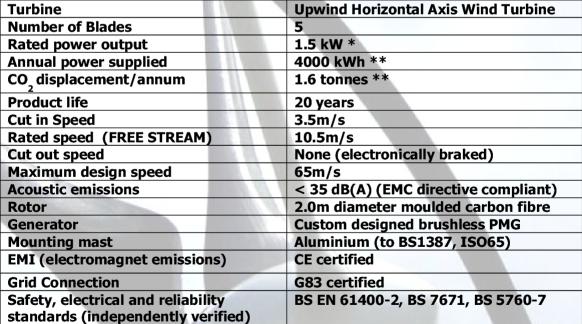
So that’s a diameter of 2m, rated wind speed of 10.5ms-1, and a rated power of 1.5kW. Plugging that into my simplified Cp equationCp = P / ( 0.48106 d2 v3 )
which gives:
Cp = 1500 / ( 0.48106 × 22 × 10.53 ) = 0.67
As this is higher than the Betz Limit of 0.59, the claimed power output of the Swift wind turbine is theoretically impossible.
I don’t know how to put this, but rooftops are sheltered places; if they get any wind at all, it tends to be turbulent and highly directional. You get huge updrafts, none of which help generate power. I know of some very open sites that struggle to get the 3.5ms-1 cut-in speed of the Swift, and that speed is at 50m+, not on a rooftop.
Renewable energy, for me, is about using the appropriate technology for the right location. Devices like the Swift are a distraction from the whole conservation/renewables agenda.
-
Windsave, again
Anent my previous rant about Windsave claiming impossible efficiencies, they’ve made some changes to their website. The machines now have larger diameters (1250 and 1750 mm — up from 1000 and 1400mm), and much lower rated power (500W and 1000W at 27mph — down from 750 and 1200).
Plugging in those numbers to Cp = P / ( 0.48106 d2 v3 ), we get more realistic efficiencies of 0.378 and 0.386 (for the small and large machines, respectively).
The Lakota turbine we installed last week has a nominal rated power of 900W at 28.8 mph for a 2.09m diameter rotor. It has a very conservative Cp = 0.20, although David Cooke says that typically they see 1,000 Watts at around 25mph (a Cp of around 0.34).
At the other end of the scale, the Lagerwey LW52 is a 51.5m diameter machine rated at 750kW at 12ms-1. This advanced utility scale, variable pitch machine has a Cp = 0.34.
Windsave’s revised figures are much more credible, but until we have real figures backed by a few years of installations, there’s little more we can say about them. I’m a little concerned that, although there are claims that 1000s of these machines have been sold, there’s not a single real photo of one on the web.
I’m going to enjoy putting up an anemometer and logging system alongside the urbine downtown. We’ll see how it runs.
-
Yet another Scottish rooftop turbine
Anent the WindSave turbine, yet another similar product has appeared: the Renewable Devices Swift. It’s Scottish too, and again there are few details. The Scotsman has the story.
Someone commented here that one could build such a device cheaply from parts from any DIY store. This isn’t quite the case. Properly formed blade sets are not trivial to make, and while you could build your own generator, weatherproofing it and making it CE-compliant would be hard.
-
WindSave cleans up
If you go to WindSave’s website, you’ll note that their performance claims have gone.
Update, 5 April 2004: I am no longer supplying their PDF brochure. WindSave does not seem keen to back up their product with reliable technical information. If their original dimensions were accurate, here is all you need to know about WindSave’s designs (and why they won’t work) .
-
WindSave: All Betz Are Off!
Update, May 2005: While it’s true that WindSave appear to have made their device obey the laws of physics (at least according to their published spec), I’m keeping this posting intact.
If the data on their website are to be believed, WindSave cannot generate the figures they claim. There’s much geeky theory involved, but basically, they’re claiming efficiencies that cannot be attained.
In short, they are claiming coefficients of performance of 0.724 and 0.887 for their turbines. Unfortunately, the theoretical maximum efficiency for a wind turbine — the Betz limit — is 0.593. So something, somewhere, is screwy. I’m pretty sure it’s not my sums, as they’ve been verified by an external source.
I worry that the UK energy minister, Brian Wilson, has been taken in by this. Five minutes with a calculator and a wind energy primer shows that these things are too good to be true.
(more…) -
the little turbine that …
Seems that a little turbine from my old hometown is causing quite a
stir. The WindSave looks like it plans to be a distributed project of 1000s of micro-turbines, each “phoning home” to report its production to a central site.Contentious article in The Guardian, which I already know that Paul Gipe has had a good grouse about.
I don’t see what this does that a Marlec doesn’t. I’ve sent for more info.
I’d hate to have to consign this to my “Wind Energy Annoyances” folder,
but it may be heading that way. And I’m very, very suspicious of any
wind turbine that’s backed by Country Guardian, the UK’s anti-wind energy, pro-nuclear group.