Hey! If you want a variant with full ASCII coverage, go here: A73.
A rendering of the ECMA-42 standard bitmap printer font from 1973.
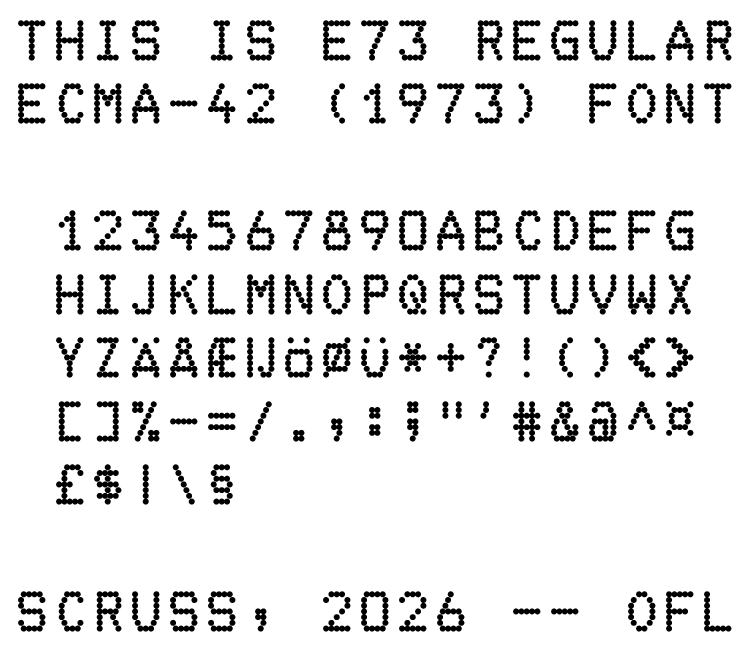
Also on github: scruss/E73: ECMA-42 standard printer font from 1973.
Name
E from ECMA, and 1973 for its publication year.
Coverage
ASCII, mostly. The standard did not provide definitions for these characters:
- U+005F _ LOW LINE
- U+0060 ` GRAVE ACCENT
- U+007B { LEFT CURLY BRACKET
- U+007D } RIGHT CURLY BRACKET
- U+007E ~ TILDE
As this is an attempt to faithfully implement a standard, these characters were not synthesized. In a slight concession to modernity, glyphs for A–Z have been copied to a–z.
The standard also defines the following extended characters:
- U+00A4 ¤ CURRENCY SIGN
- U+00A3 £ POUND SIGN
- U+00C6 Æ LATIN CAPITAL LETTER AE
- U+00C5 Å LATIN CAPITAL LETTER A WITH RING ABOVE
- U+00C4 Ä LATIN CAPITAL LETTER A WITH DIAERESIS
- U+00A7 § SECTION SIGN
- U+0132 IJ LATIN CAPITAL LIGATURE IJ
- U+00D6 Ö LATIN CAPITAL LETTER O WITH DIAERESIS
- U+00D8 Ø LATIN CAPITAL LETTER O WITH STROKE
- U+00DC Ü LATIN CAPITAL LETTER U WITH DIAERESIS
Design Size
The 12 point design size is meant to reproduce 10 characters per inch horizontally, and six lines per inch vertically. This is a requirement of the standard to match OCR fonts of the day.
Variants
None. This is an attempt to reproduce the character forms exactly according to the standard document.
Source
While this font is produced entirely by one Python FontForge script, the code is too ugly to include here. The included ecma42.json is likely more useful: it contains all of the pin definitions keyed by character name.
Licence
© 2026 – Stewart Russell, scruss.com with Reserved Font Name E73
This Font Software is licensed under the SIL Open Font Licence, Version 1.1.
https://openfontlicense.org/
[I do not agree with SIL’s missionary work in any way, and the use of this licence is in no way an endorsement of SIL.]
Reference
- ECMA-42: Alpha-numeric character set for 7×9 matrix printers; 1st edition, December 1973 (withdrawn): “This Standard defines the printed image and the nominal dimensions of a font for 7×9 matrix printers. The characters have been designed for both human and machine readability.”
Leave a Reply