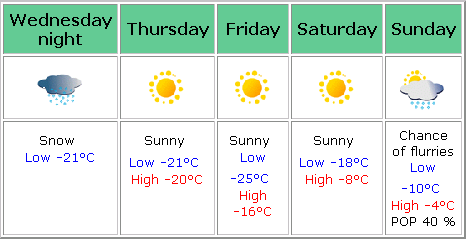
Yes, it’s cold. On the way to the TTC, my thermometer said -25°C. It was so cold the other day that, in the five minute walk back from the coffee shop, my colleague Derek’s pastry froze solid.
Yes, it’s cold. On the way to the TTC, my thermometer said -25°C. It was so cold the other day that, in the five minute walk back from the coffee shop, my colleague Derek’s pastry froze solid.
Democracies depend on the political participation of its citizens, but not in the workplace
— sign in a Tyson chicken processing factory, Springdale, Arkansas.
(quoted in Utne, Jan-Feb 2004.)
A year ago today, I started playing banjo. None of that “Duelling Banjos” picking style, either — this is old-time 5-string clawhammer, or frailing. I can play a few tunes, given the best efforts of my teacher Chris Coole.
If you’re in Toronto on January 31st or February 1st, it’s worth seeing Chris play at the Flying Cloud Folk Club as part of the annual Banjo Special event. Last year was amazing; this year can only be better.
I also owe a lot to approximately 50% of the Holy Modal Rounders, Peter Stampfel. When he heard that I was taking up the banjo, called me from New York with tips on getting started. This quite unnecessary act of kindness seems typical of the banjo community.
After looking for about 10 years, I finally found macha again at The Big Carrot. The importer is CJay Tea.
Macha is the light green fine-ground “tea ceremony” tea. I had it in Japan, both as tea and possibly the best flavouring for ice cream ever. It’s good. I’ve read conflicting reports of its caffeine content; some people say it’s very low in caffeine, but I always got a monstrous buzz from it.
Just to make sure I’m getting enough of The World’s Favourite Alkaloid™, I also got some green Sumatran coffee beans and a grinder while I was at the Carrot. Local company Merchants of Green Coffee deserve the credit/blame.
My host doesn’t support the graphics library that Movable Type prefers for making thumbnail images. Six Apart shows you how to use NetPBM, which is supported.
I also discovered that the version I’m running doesn’t do PNG graphic handling. That’s easily fixed. In lib/MT/Image.pm, change the line:
my %Types = (jpg => 'jpeg', gif => 'gif');
to:
my %Types = (jpg => 'jpeg', gif => 'gif', png => 'png');
As a Perl guy, I’m mildly horrified with the way this code works, but it won’t bite most people.
I got pointed at ihaveanidea.org by Caroline, who recommend it for a friend who’s looking for an advertising internship.
They have TV ad showcases on the site, and I found this New, by hotdogboy. It’s odd.
These scripts can be ignored if you’re not likely to be working with PostScript files. I wrote/modified these ages ago, and hope someone can use them.
Download epstotiff – convert an Encapsulated PostScript figure to just about any raster format.
Download bbox – calculate the BoundingBox of a page. Should probably be combined with epstotiff.
Download joinps – concatenate a number of PostScript documents.
You’ll pretty much need a Unix box with ghostscript to make these work.
Today was the first “freezing nose” experience of the winter. Combined with my pre-work swim, this has resulted in the unpleasant experience of only being able to smell chlorinated meat all day…
The iPod Mini: 4GB, US $249, available next month in the US, April worldwide. A larger capacity and higher price than many people expected.
This would have been neat if they hadn’t brought the price of the 15GB iPod down to US $299. That’s 375% the capacity for 120% the price of the iPod Mini. And I guess there will be a raft of the discontinued 10GB iPods hitting the market soon.
I would have paid US $150 (CA $192, probably not including the Canadian media tax) for a 2GB unit. I’ll have to think longer and harder about what they’re offering. Apple have never really done the low-end very well.
NASA SP7010, aka Clarity in Technical Reporting by Dr. Samuel Katzoff, manages to say more about technical writing in 30 pages than most books ten times the size. There’s not a single illustration or bullet point, yet it’s lucid and precise.
It seems that Dr Katzoff took special care to ensure that young engineers at NASA knew how to communicate. As chief scientist at the NASA Langley Research Center, he certainly knew the importance of good technical reporting.
NB: I had assumed that Dr Katzoff, from various sources on the internet, had passed on. I’m told (see below) he’s alive and well. If he didn’t say something in Clarity in Technical Reporting about checking sources, well …
Best wishes to Dr K., anyway!
Most Unix systems, and Linux being one of them, use a configuration file called fstab to specify where the various disk drives are to appear on the system. Here’s an excerpt from one of mine:
 /dev/hda7     /             ext3    defaults        1 1
 /dev/hda1     /boot         ext3    defaults        1 2
The first column specifies the device name. In this case, /dev/hda is the first hard disk, and it has (amongst others) partitions 1 and 7.
More recently, however, it has been possible to label partitions. So instead
of the above, you might have:
 LABEL=/       /             ext3    defaults        1 1
 LABEL=BOOT    /boot         ext3    defaults        1 2
This seems like a good idea until you have to add in a hard drive, as I did recently. If both drives use the ‘LABEL=BOOT’ syntax, the system gets confused as to which drive to boot from, and hangs.
I’ve changed all my systems back to use the older, more cryptic ‘/dev/hd??’ method. I don’t intend to swap drives in and out, but at least this way, I’m ready if I have to.
Sometime last year, PepsiCo, Inc bought Quaker. You’ll remember that PepsiCo Inc was the company that had no problem working with the military rule of the State Law & Order Restoration Council (SLORC) in Burma (Myanmar). After a large amount of negative publicity, PepsiCo pulled out of the deal in 1997.
I try to be a quaker, though I’m not very good at it yet. I’m not happy with corporations trading on the integrity associated with the name of the Religious Society of Friends, especially when these corporations do not act in a manner in keeping with the tenets of Quakerism.
I guess if a group of members of the Religious Society of Friends started selling organic oatmeal, they could call themselves Quaker Oats. After all, the now-unit of PepsiCo only registered their trademark in 1877, yet the name Quaker
was coined in the 1650s…
The Proven Windlogger is clever. It uses a simple bike computer (looks like a Cat-Eye Velo) to measure wind run.
I know that Gordon Proven is a bit of a bike-nut, back from my days with the BWEA. This is the sort of simple, neat design that Proven does so well.
I just printed one of my bank transactions. All the content fitted nicely on one page. But Mozilla, for no good reason, decided that it would print a second page with no content beyond its headers and footers.
I hate it when this happens. Mozilla shouldn’t print trailing whitespace. And if a printout uses only 10% (say) of the last page, the job should be re-run at a slightly smaller scale to make it fit.
It’s not hard to do, and it would save a lot of paper.
I’ve just finished reading Jesse James: Last Rebel of the Civil War, by T. J. Stiles. A fascinating book, it describes the Missouri/Kansas border of the 1860s-1870s with the same level of horror as 1990s Kosova/Kosovo.
I know the area well. Catherine grew up in Liberty, and her mother still lives on Franklin Street, the site of the 1866 raid on the Clay County Savings Association by a gang including Arch Clement and the James brothers. The James family made their home in Kearney, the town which used to have my favourite diner, Clem’s Café.
After the civil war, veterans returned home with their weapons, and used them to settle old scores. Stiles makes the point that carrying handguns was rare before the war, so this is a possible root of the US’s gun crime problem.
But what struck me most was the amazing names that cropped up in the book: Adelbart Ames, Delos T. Bligh, Schuyler Colfax, Alvis Dagley, W. L. Earthman, Aber Gilstrap, Odon Guitar, Nimrod L. Long, Zerelda Mimms, Sidney G. Sandusky (who, coincidentally, built the house in Liberty that Catherine grew up in), Theodrick Snuffer, Flourney Yancey, and my favourite, Greenup Bird. You just don’t get names like that any more. These are solid names, they’ll see a lifetime through.
Remember when office walls were festooned with grubby, wonkily photocopied slogans, bad attempts at Snoopy cartoons, and all manner of xerox-worn paperwork? Something like this:
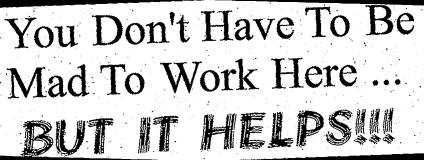
With everything being digital, and e-mailed the world over without degradation, I became nostalgic for the old analogue days. So I decided to emulate the squint, black-edged, mottled, heavily-thresholded imagery with the NetPBM toolkit and a shell script. You can download it here: pnmcopier – emulate a badly-photocopied document to stdout. It should work on most Unix machines. It does require that your shells sets $RANDOM, which might make it a bit bash-specific.
It works best with a fairly high resolution image. Be advised it’s a processor hog; it has to rotate, smooth and merge very large images. To compound the effect, pipe the output into pnmcopier, perhaps several times. I don’t quite have the parameters right, but it gives the desired level of grubbiness. Sorry I couldn’t reproduce coffee stains, staple marks, old tape ghosts or random doodles.
Do what you will with it, but harm none.
To Katie & Joe Raine in St Louis, baby Emma is born today. She shares her birthday with her Aunt Catherine.
IBM
DB2 just gave me this far from helpful error
message:
DB21034E  The command was processed as an SQL statement because it was not a
valid Command Line Processor command.  During SQL processing it returned:
SQL0010N  The string constant beginning with "'" does not have an ending
string delimiter.  SQLSTATE=42603
As a human, or a close facsimile of one, I don’t need to
know the internal server codes DB21034E
and
SQL0010N
. I don’t need to know that the command was
processed as an SQL statement, because that’s what I was
hoping it would be all along. And I definitely don’t want
to know that SQLSTATE is 42603, for I’m not sure if it
would be very much better or worse if it were 42604. Or 2.
Or, for that matter, 999999999996.
And all this for mismatched quotes around a string.
So I’m typing this into Mozilla, which contains full-featured mail and HTML editors. Yet, why am I stuck with a primitive editor in my forms? Why can’t I spellcheck, do file management and format text?