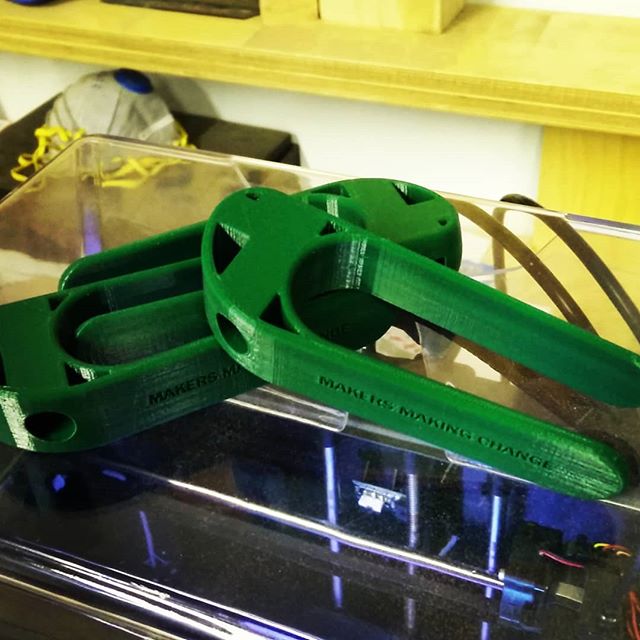
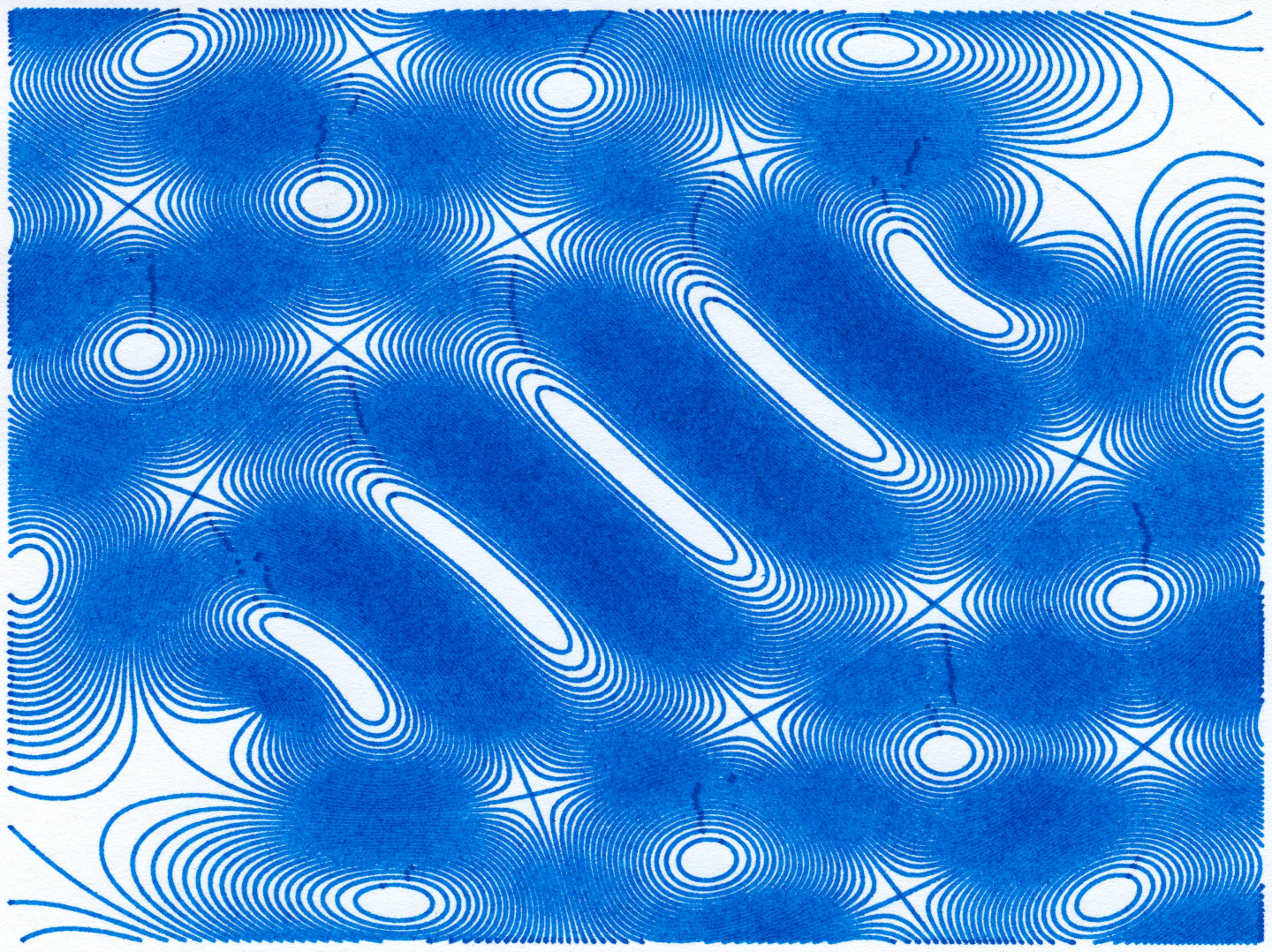
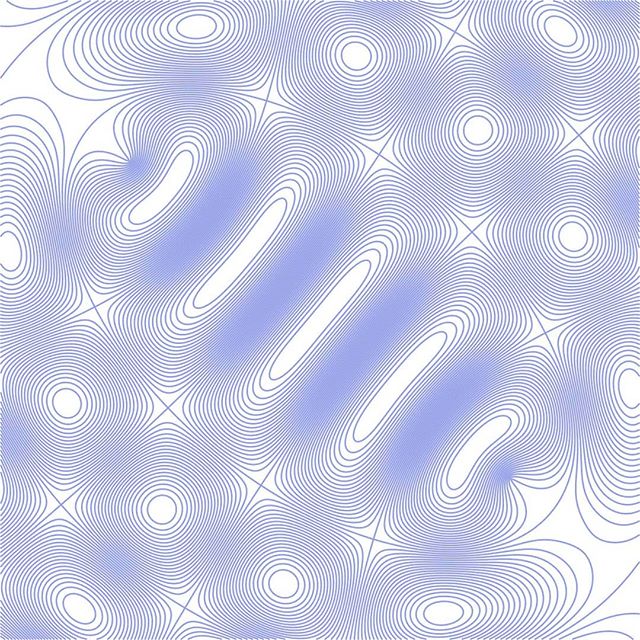
I’m still a sucker for vase mode/spiral contour prints … this one made in OpenSCAD:
Thanks to Andrew at ProtoLab for the loan of the PrintrBot. I’ve got a demo at UofT on Wednesday, and my Reach 3D isn’t exactly portable. Yeah, I should probably get a cheap Monoprice printer to lug around to occasional demos, but I’d need to find a donor …
Thingiverse‘s Customizer allows users to customize suitable OpenSCAD models without knowing any OpenSCAD code. While it does have some documentation to help developers along, there’s still a lot of guesswork.
I released my first (working!) Customizer design the other week: Parametric Finger Pen Holder (Vertical). While the docs are the primary source of developer information, you might want to know the following:
Customizer assumes that every variable defined before the first module definition in the script is a user parameter. To give it a hint that it should stop displaying variables, add an empty module (such as module naff() { }) after the last variable definition you want Customizer to display.
(There’s supposed to be a CUSTOMIZER VARIABLES/CUSTOMIZER VARIABLES END comment pair that will do this too, but it didn’t work for me)
Customizer will fail if there’s any character other than strict ASCII in the script, and won’t give useful diagnostics about the problem. Check your comments for accents and fancy punctuation
Customizer displays a real-time preview of your model. This means the rendering will be a little rough, especially if you use set operations such as union(), difference() and intersection(). If you have to hit F6 to render your model in OpenSCAD properly, it’s going to look a bit off in Customizer
If you must use resource-intensive functions such as hull() and minkowski(), try to limit them to 2D paths that are subsequently extruded. Everyone else in the Customizer job queue will thank you
Similarly, keep the circle smoothness variables ($fa, $fn, $fs) in sensible ranges
Customizer creates a new Thing under your name rather than just letting you download your customized model. You likely want to delete that once you’re finished with it.
(This also means that Customizer only works for registered Thingiverse users. I can’t see any way around this, unfortunately)
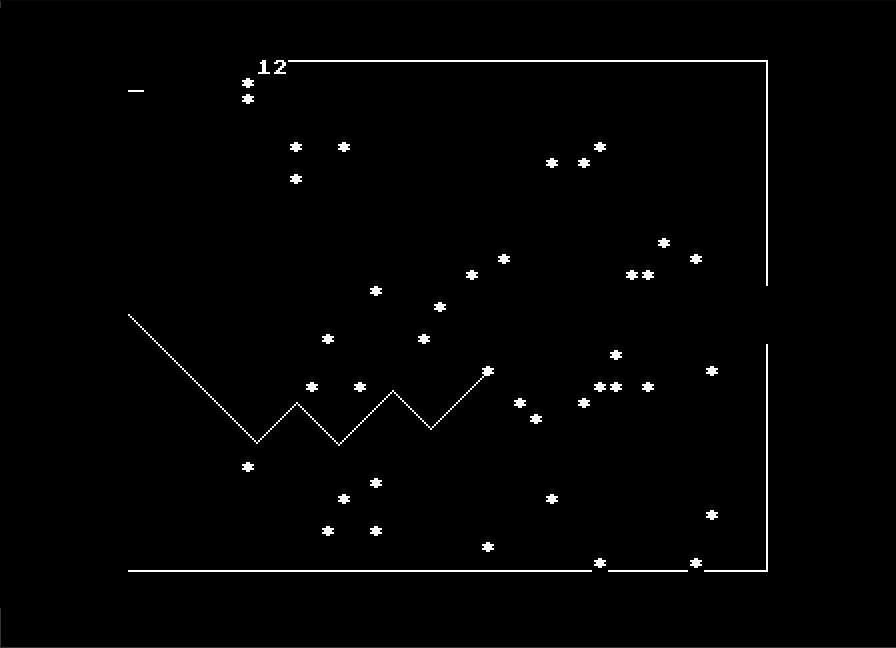
Thanks to users sbadger and lurkio on the stardot forum, I’ve been reunited the original BBC BASIC one-liner that begat 2d Star Dodge/Stardodger: Asterisk Tracker!
Asterisk Tracker
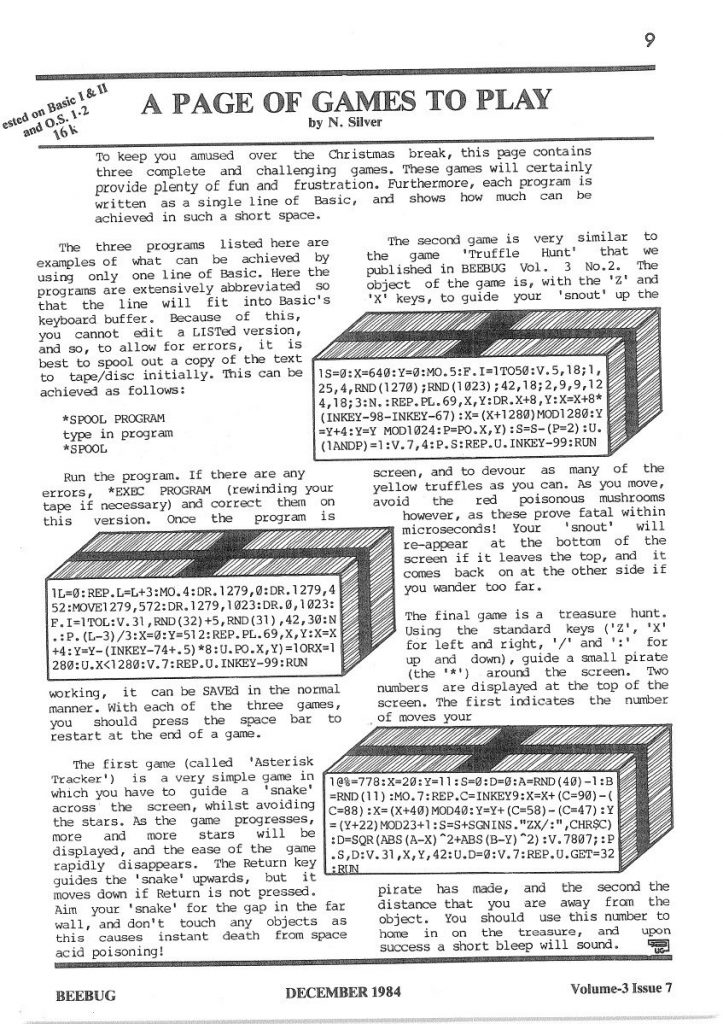
It was published in the December 1984 edition of BEEBUG Magazine (vol. 3, issue 7; page 9) and is credited to N. Silver.
It makes extensive use of BBC BASIC’s abbreviations, and the writeup even warns
… Here the programs are extensively abbreviated so that the line will fit into Basic’s keyboard buffer. Because of this, you cannot edit a LISTed version, and so, to allow for errors, it is best to spool out a copy of the text to tape/disc initially. This can be achieved as follows:
*SPOOL PROGRAM type in program *SPOOL
The program unwinds to something much more understandable:
   10 L=0
   20 REPEAT
   30   L=L+3
   40   MODE 4
   50   DRAW 1279,0
   60   DRAW 1279,452
   70   MOVE 1279,572
   80   DRAW 1279,1023
   90   DRAW 0,1023
  100   FOR I=1 TO L
  110     VDU 31,RND(32)+5,RND(31),42,30
  120   NEXT
  130   PRINT (L-3)/3
  140   X=0
  150   Y=512
  160   REPEAT
  170     PLOT 69,X,Y
  180     X=X+4
  190     Y=Y-(INKEY(-74)+.5)*8
  200   UNTIL POINT(X,Y)=1 OR X=1280
  210 UNTIL X<1280
  220 VDU 7
  230 REPEAT UNTIL INKEY(-99)
  240 RUN
The instructions are typical of the day:
The first game (called “Asterisk Tracker”) is a very simple game in which you have to guide a “snake” across the screen, whilst avoiding the stars. As the game progresses, more and more stars will be displayed, and the ease of the game rapidly disappears. The Return key guides the “snake” upwards, but it moves down if Return is not pressed. Aim your “snake” for the gap in the wall, and don’t touch any objects as this causes instant death from space acid poisoning!
Um, yeah, N. Silver, whatevs …
It’s pretty amazing that three type-ins could fit on a page: especially when you consider that the BEEBUG magazine was A5!
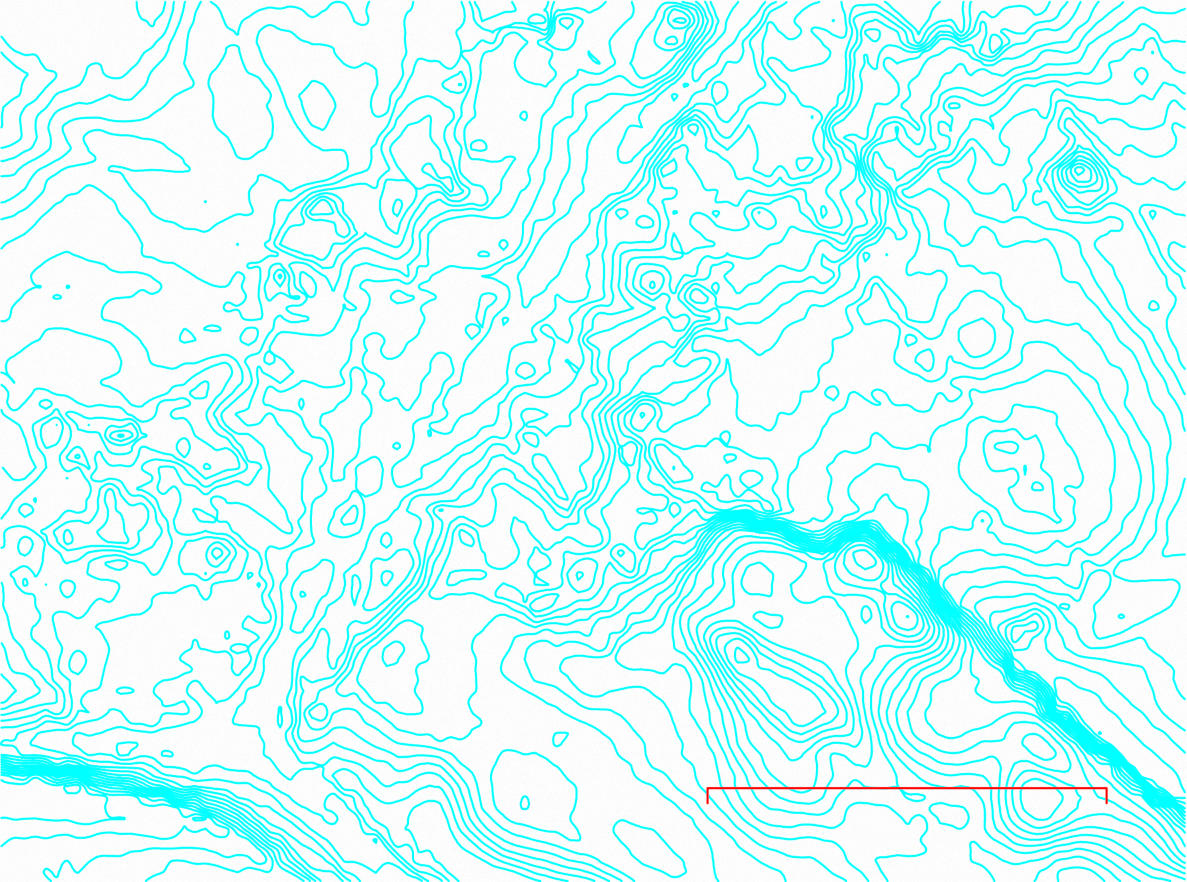
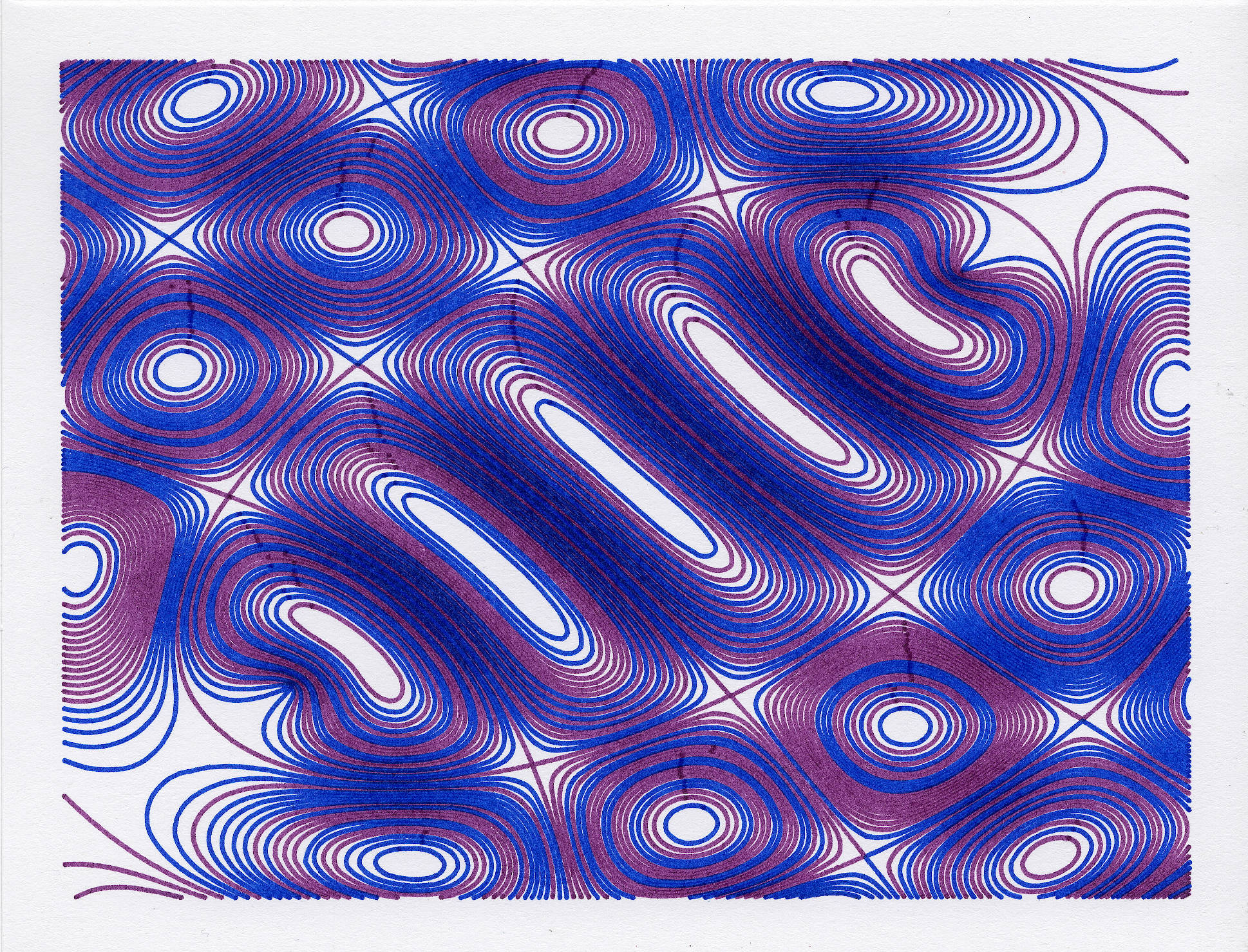
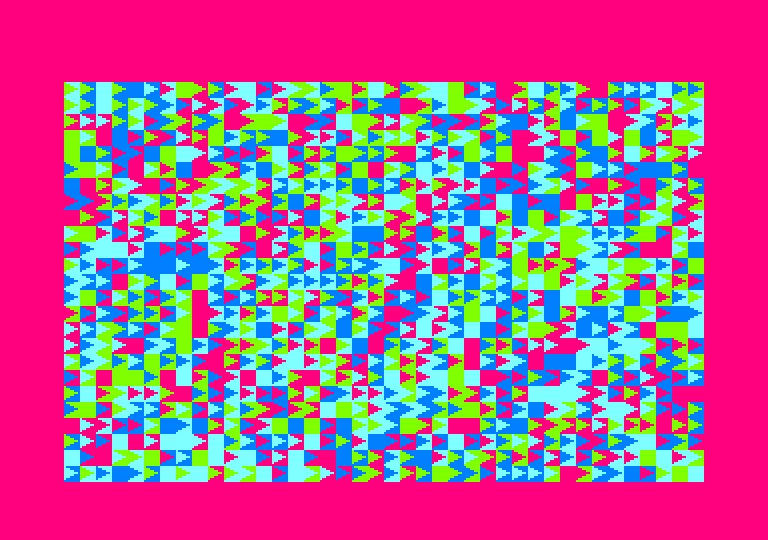
this, but with alternate lines from the plot file drawn with alternate pens. The original was slow because it had a point roughly every 0.1 mm, and this has been smoothed. Still took maybe 15-20 minutes to draw, though.
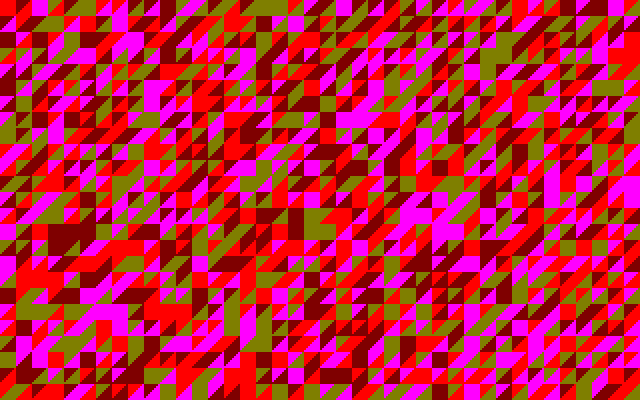
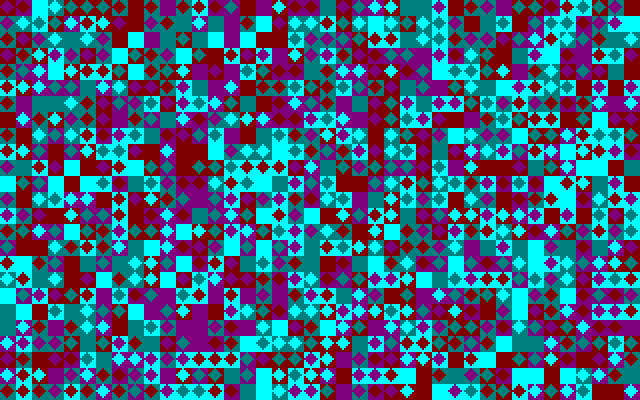
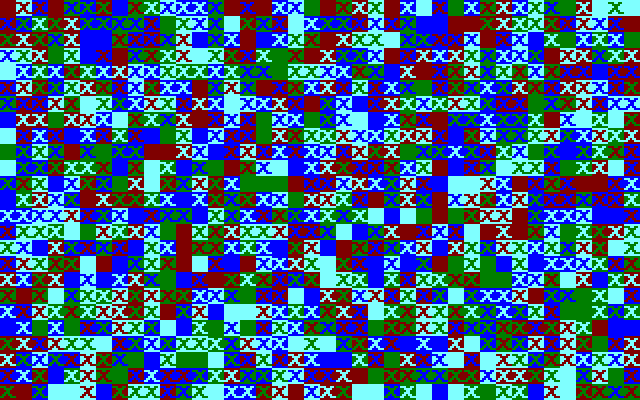
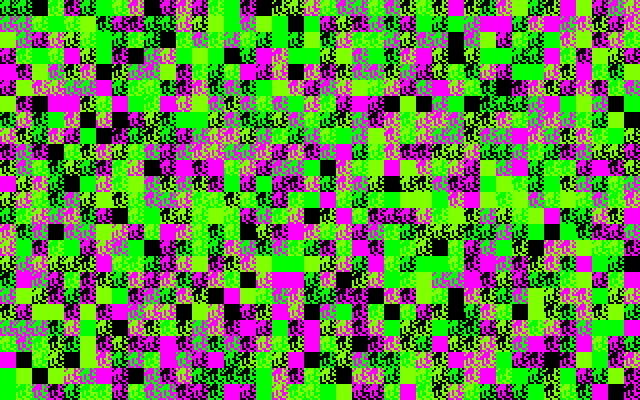
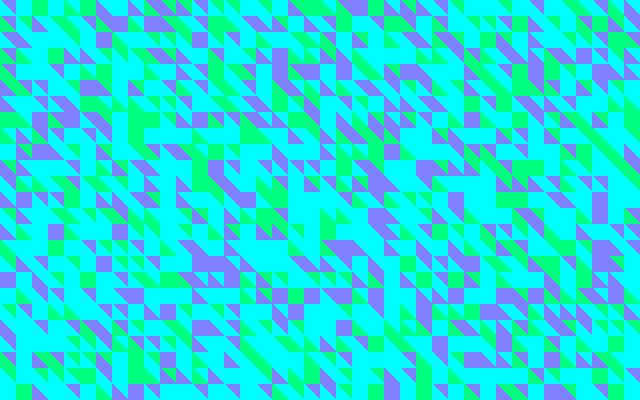
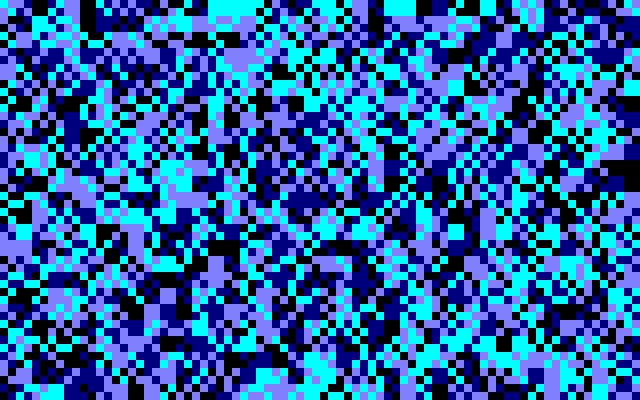
No, really: this *was* the seat pattern on Western SMT buses circa 1979
Because I care (and don’t if you don’t), here’s the Locomotive BASIC source, lovingly typed into the Caprice32 emulator then extracted as text using iDsk:
10 ' British Council Tile / Bus Fabric Sim

20 ' by Rob Manuel 2018

30 '

40 ' z/x - change char up/down (ascii)

50 ' space - random palette

60 ' c - show ascii val, inks & pause

70 ' v - random character (128+ ascii)

80 ' b - random char and cols

90 ' n - fill with same line & pause

100 'i - input ascii value

110 '

120 ON BREAK GOSUB 260:MODE 1:LOCATE 1,26

130 DEF FNs=INT(RND*255)

140 SYMBOL 255,FNs,FNs,FNs,FNs,FNs,FNs,FNs,FNs

150 DEF FNp=INT(RND*4)

160 DEF FNi=INT(RND*26)

170 GOSUB 470

180 GOSUB 270

190 o$="":i$=INKEY$

200 IF i$<>"" THEN GOSUB 380

210 FOR i=1 TO 40

220 w$=CHR$(14)+CHR$(FNp)+CHR$(15)+CHR$(FNp)

230 w$=w$+CHR$(c):o$=o$+w$:NEXT i

240 store$=o$

250 PRINT o$;:GOTO 190

260 CALL &BC02:PAPER 0:PEN 1:END

270 aa=FNi:bb=FNi:cc=FNi:dd=FNi

280 INK 0,aa:INK 1,bb:INK 2,cc:INK 3,dd

290 BORDER aa

300 GOSUB 320:RETURN

310 IF c>255 THEN c=32:IF c<32 THEN c=255

320 LOCATE 1,1:PAPER 0:PEN 1

330 PRINT "C:"c;

340 PRINT CHR$(c);

350 PRINT " ";

360 PRINT "I:"aa;bb;cc;dd;

370 LOCATE 1,26:RETURN

380 IF i$=" " THEN GOSUB 270:RETURN

390 IF i$="z" THEN c=c-1:GOSUB 310:RETURN

400 IF i$="x" THEN c=c+1:GOSUB 310:RETURN

410 IF i$="c" THEN GOSUB 310:CALL &BB18:RETURN

420 IF i$="i" THEN LOCATE 1,1:INPUT "ASCII?",c:GOSUB 310:RETURN

430 IF i$="v" THEN GOSUB 470:GOSUB 310:RETURN

440 IF i$="b" THEN GOSUB 270:GOSUB 470:GOSUB 310:RETURN

450 IF i$="n" THEN FOR i=1 TO 25:PRINT store$;:NEXT:CALL &BB18:RETURN

460 RETURN

470 c=INT(RND*128)+127:RETURN