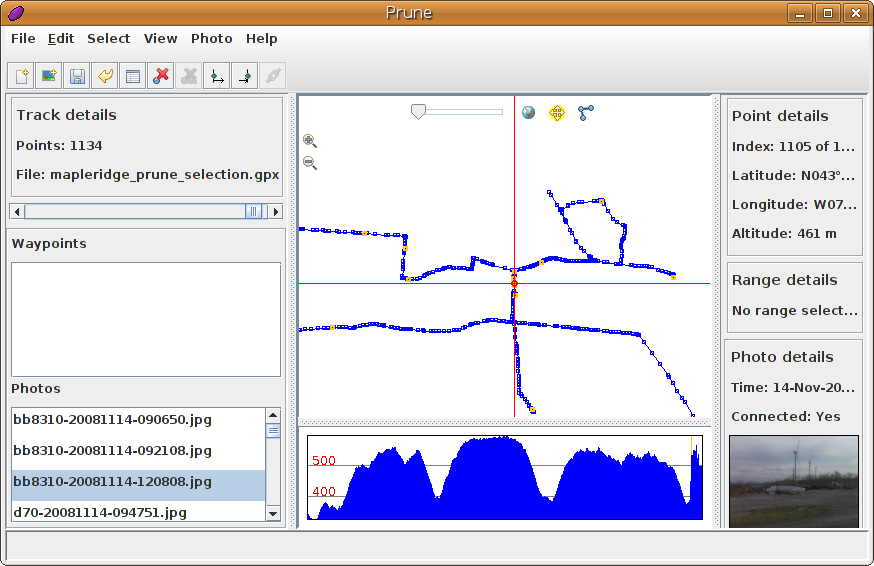
Just spent a pleasant morning munging gps data and photos using Prune. It has allowed me to edit a complex GPS track, add many photos, correctly correlate them to GPS locations, and save it all back out in a variety of useful formats.
I see that the author is talking about producing a native KDE version. Noooo! I like my Java. It runs everywhere.
(Incidentally, I see that with the recent software update, the Blackberry Curve will now geotag images from the camera. It’s now a really good “I was here” device – coming close to the “Utensil” that Robyn Hitchcock spoke about years ago.)
I am trying to speak to my computer I’m not sure it understands the two well actually it’s doing not badly I’m speaking in a rather disjointed manner I have to go to New York state tomorrow I’m not quite sure why I have to look at twin turbo inns no I don’t have to look at twin turbo ends I have to look at wind turbine what’s
While it’s remarkably accurate I’m going to be really mean and bald face and sure I don’t know “bold face is that I’m going to be located anyway, to your things have calmed pear shaped nine
This is the voice of the Mr. Owns and I do I think I’m going to live. I suppose this is better than I expected especially since Mike accent is unusual most people in Canada do not understand a and so finally I have a computer that understands the this is a bit worrying isn’t it?
Well that wraps it up for dictation. You have a pleasant evening. Good night!
– what Microsoft speech recognition thinks I said. The random “what” and “nine” is me starting to laugh, and “bald face” is “blog this”.
I revived Catherine‘s old (old?! it’s less than half a decade old!) iPod Mini with a new battery from iDemiGods. The kit was under $10 shipped, and took about 10 minutes to install.
Strange how large and clunky the Mini feels compared to recent players. Of course, I immediately installed Rockbox …
Update: If you have a recent NetPBM, this is fixed.
I’d previously alluded that netpbm’s pgmnoise wasn’t as random as it could be if you called it several times in quick succession. Nerdy discussion after the break, but here’s a (perhaps slightly linux-centric) alternative:
#!/bin/sh
# pgmrnoise - a more random pgmnoise; limited to 8-bit images
# created by scruss on Sun Oct 12 19:36:37 EDT 2008

echo P5
echo $1 $2
echo 255
dd if=/dev/urandom bs=$1 count=$2 2> /dev/null
I just pasted the shell text in there; you’ll need to save it as a file. It works the same way as pgmnoise:
pgmrnoise width height > noise.pgm
It is limited as written to 8 bit-per-pixel output, but is a fairly trivial edit to make it 16 or more bits.
I’d totally put these up on my walls, but I may end up climbing them:
I made them by taking 32×32 pixel tiles of random grey noise, Atkinson dithering them (using pamditherbw) then vectorizing them using potrace. If you click on the tiles, you can download/view the PDF source of each.
(pgmnoise, the source of the grey noise, relies heavily on the system time as its seed. Before I introduced a delay between image generation, several images appeared almost identical.)
mp3 tagging is a minefield. Like all metadata, one has to balance obsession with detail against ease of acquisition.
Some Firefly clients are pickier than other about tagging. Regrettably, some of the music I get from emusic has bad characters in the tags, which throws the players right off. Finding the problem files is the majority of the problem – here’s a method that at least helps: wget -O- http://host:port/rsp/db/1 | perl -pwe 's,<(?![/\?]),\n<,g;' > firefly.xml
xmllint --noout firefly.xml
You’ll likely get a few lines like:
firefly.xml:463415: parser error : PCDATA invalid Char value 65535

<title>�Singing in the Bathtub</title>
In this case, the song title tag has some junk characters in it that you’ll need to fix. After cleaning up the tags and rebuilding the database, try this process again to see if you’ve caught all the errors.
Yes, I really have opted out from the MAKE e-mail list. If I get any more e-mail, O’Reilly — formerly publishers of useful Unix books with animals on them — are just a bunch of filthy spammers.
Kind of what my iPod now does, until the battery runs out
I have, well had, a 2GB second-gen iPod Nano. Now I have a very slim brick.
When I upgraded to iTunes 8, it offered an update for my iPod. I let it do its thing, then resync’ed it. I noticed that the iPod rebooted after the sync — no big deal — but then kept rebooting (back and forth …) forever.
I tried resetting it; nope, it would just start doing its thing again.
I tried putting it into disk mode, then restoring it; nope, back and forth, back and forth …
In desperation, I tried restoring it on a PC, which needed to reformat the iPod. Partial success; it sync’ed music from the PC, but since my working music library is on my iBook, I had to restore and resync, and guess what? back and forth, back and forth …
I’d heard that the problem could be caused by empty podcast folders, so I cleared out and rebuilt my library, put the iPod into disk mode and restored it on a PC, resync’ed on the iBook and … back and forth, back and forth …
As a last try I’m going to fsck it under Linux. I might be stuck using yamipod, which is probably a bonus, as all I use iTunes for is as an iPod conduit. I really miss having a Rockbox-capable player, as it just worked the way I expected.
UPDATE: yeah, that last one did it. Shame about yamipod’s UI.
VirtuaWin adds joy to my desktop: using my 1280×800 laptop with a Dell 1920×1200 flat panel with four workspaces, I’ve got over 13 million pixels at my command. I have the laptop screen dedicated to my Vestas Online Busines SCADA session, so by making the SCADA window sticky, it’s always visible as I move from workspace to workspace on my big screen.
Shame the underlying OS blows pickled pineapple, though.
If you run Firefly Media Server, you can run this script to create an M3U of all the tracks on your server. You can play this in most audio players; VLC likes it, as does iTunes (though big playlists take an age to load). Rhythmbox and the default Ubuntu Movie Player won’t touch my playlist of over 17,000 tracks.
To configure the script you need to edit three lines:
# where the Firefly database lives

DATABASE="/usr/var/cache/mt-daapd/songs3.db"

# server domain name or IP address

SERVER="server.example.com"

# Port to talk to server - don't leave blank

PORT="3689"
If you’re running Ubuntu, you’ll probably only need to change the SERVER line. It spits the M3U playlist, ordered by album, to stdout. Note that in the default Ubuntu install, regular users can’t read the database file.
If you’re running this from a cron job, it’s probably a good idea to fill in the real paths for sqlite3 and awk.
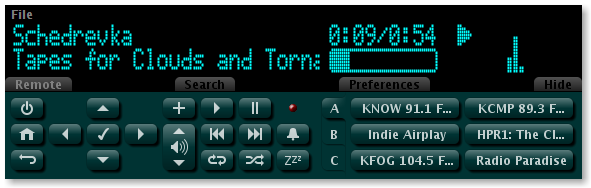
for submitting The Music Tapes‘ Music Tapes for Clouds and Tornadoes to freedb under the genre reggae; all the other genres I tried had a disc ID clash.
Above all, though, draw a tiny musical note on your acorn.
1492 Artists / 999 Albums / 15245 Tracks / 34.9 Days / 62.12 GB
(and here’s me thinking I had about 2000 CDs, too)
CDs that wouldn’t read: 0 (so far). That’s not to say that there weren’t some difficulties (copy-controlled CDs can go die, glitching and gronking in my drives) and my oldest CD (XTC’s Skylarking, my copy of which I think has just turned 20) had a ton of retries.
Lost CDs: Thomas Dolby’s Aliens Ate My Buick is somewhere in the house, but nowhere I’ve looked.
Found CDs: My long-lost promo copy of the (Portland) Decemberists’ Picaresque, which I thought had vanished in a road trip to Missouri. It was lurking in a long-forgotten portable CD player in the bottom of a storage bin.
Pleasant surprises: that freedb is generally better than it used to be.
Peeves: copy-controlled CDs (see above); flappy cardboardy cases that only have the title on one spine; oversized CD cases (Japanese imports, I’m looking straight at you), dark blue text on a black background, idjit freedb submitters who insist on Band, The syntax or worse, submit whole albums called sdfsdf;aefhsdf; bonus DVD “premium” releases (who watches these?).