This isn’t quite right yet – characters aren’t encoded correctly, and it’s not quite as monospaced as it should be, but it has some nostalgia value. It’s the screen font used by the Amstrad CPC.

Font: CPC-0.9.zip
This isn’t quite right yet – characters aren’t encoded correctly, and it’s not quite as monospaced as it should be, but it has some nostalgia value. It’s the screen font used by the Amstrad CPC.
Font: CPC-0.9.zip
 File: AtkNoise. Probably best at as a display font.
(The name’s from the process I used to make the font. I masked the font over greyscale noise at fairly low resolution, then applied Atkinson dithering, then fed the result through potrace. I’ve used this technique before.)
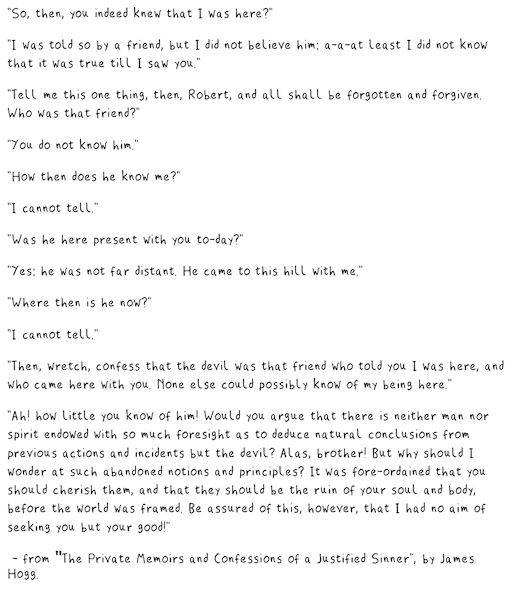
And here’s the TrueType font of that: CrapHand.ttf. Enjoy!
Hey, this post is super old!
That means that installation and run instructions may not work as well, or even at all. Most of the *Ports Apple software repositories have given way to Homebrew: you may have some success on Mac (untested by me) if you brew install netpbm fontforge potrace. There’s also some font cleanup I’d recommend, like resolving overlaps, adding extrema, and rounding points to integer. One day I may update this post, but for now, I’m leaving it as is.
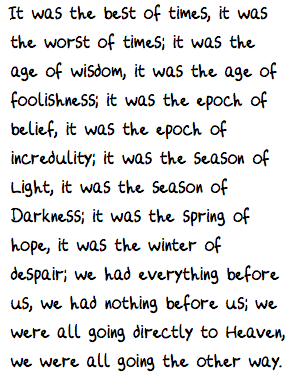
This looks more than a bit like my handwriting
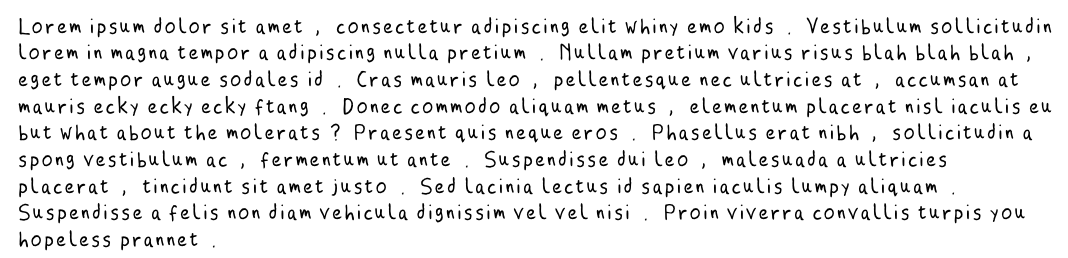
because it is my handwriting! Sure, the spacing of the punctuation needs major work, and I could have fiddled with the baseline alignment, but it’s legible, which is more than can usually be said of my own chicken-scratch.
This process is a little fiddly, but all the parts are free, and it uses free software. This all runs from the command line. I wrote and tested this on a Mac (with some packages installed from DarwinPorts), but it should run on Linux. It might need Cygwin under Windows; I don’t know.
Software you will need:
You will need to download
Procedure:
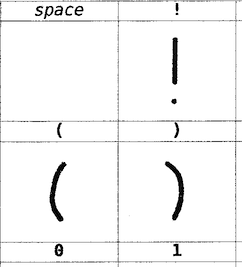 I find it helpful at this stage to clean off any specks/macules. I also scale and threshold the image so I get a very dark image at 300-600dpi.
fonttrace.pl infile.pbm | sh




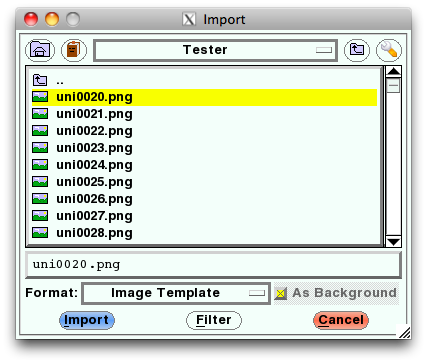
There are a couple of limitations to the process:
Lastly, a couple of extra files:
Have fun! Write nicely!
… when a federally run website doesn’t work
To be fair, it is the new  Toporama Prototype site, so it does do some slightly clever things. But still, being at an IE6 shop at work is ever amusing.
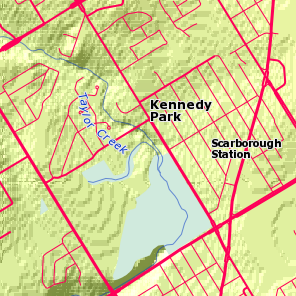
I think it has problems. Someone should tell Pine Hills Cemetery that it’s mostly underwater:
Yes, it’s nonsense:
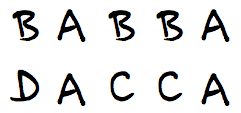
But I made these character glyphs in a semi-automatic bitmap converter for tracing in scanned letters into FontForge. It’s currently only a proof of concept, but I want to expand it up to a full ASCII font, at least.
Micropayments are a bit like legal weed – only the users want it, and the suppliers and their opponents would rather keep the status quo. Lots of smart people have tried it (remember Peppercoin? Ron Rivest was in on that one) and not many real users have ended up using it.
Flattr, like every other new system, claims to be different from every other system. It’s a patronage system, where users/readers/listeners can click on the Flattr link and divvy up their monthly contribution amongst everyone they liked.
I forget how (or exactly why) I got an invitation, but I finally activated it and credited enough for 6 months’ usage this morning. Now I need to go out and find things to like … and they’re thin on the ground.
Jag kanske inte svenska tillräckligt, but I’m not seeing much that has likeable content. Maybe my user number – in the low 1000s – is a hint, but let’s see how things go by the end of October. I’m hoping it doesn’t end up like Dexit, the dismal downtown Toronto cashless payment system that never got the inertia (or reliable terminals) needed to survive. One can never tell with these online things; when I signed up with Twitter in early 2007, it was a pretty hopeless system …
I don’t know why people keep banging on about how funny Comedy Central is, because whenever they embed a video, this is what I get:
 Am I missing something? Is it the new, newer universal punchline? Something like:
1: My dog’s got no nose.
2: How does he smell?
1: In Canada, Comedy Central Videos are available on The Comedy Network.
or
Q: What’s yellow and deadly?
A: In Canada, Comedy Central Videos are available on The Comedy Network.

As a minor celebration of our 8th anniversary of arriving in Canada, I give you (with explanation later) the collected transcripts of my Google Voice calls:
In a moment of boredom while visiting the US, I must’ve signed up for Google Voice. I’m not entirely sure what my number is, and I can’t access the account inside Canada. I haven’t given the number to anyone, yet I’m getting these voicemails. What can it mean? As a wise person once said, “Lamb oxen, but alright with equating later.”
I just got a ASUS O!Play HDP-R1. It’s one of the current crop of media player boxes, like the WDTV. I suspect they’re all the same MIPS hardware/Linux firmware inside. (Hey, you can telnet into it! Whee! Or something.)
At first, I couldn’t get it to work with my network share, but after a firmware upgrade, all is good. The new firmware offers web content, including weather. So I hopped along, and tried to access Toronto weather:
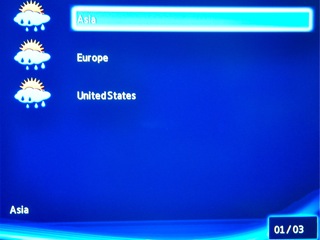 Err, some of us live outside Asia, Europe and the United States, y’know …
in pdf2ps output:
 **** This file had errors that were repaired or ignored.
 **** The file was produced by:
 **** >>>> Adobe PDF Library 7.0 <<<<
 **** Please notify the author of the software that produced this
 **** file that it does not conform to Adobe's published PDF
 **** specification.
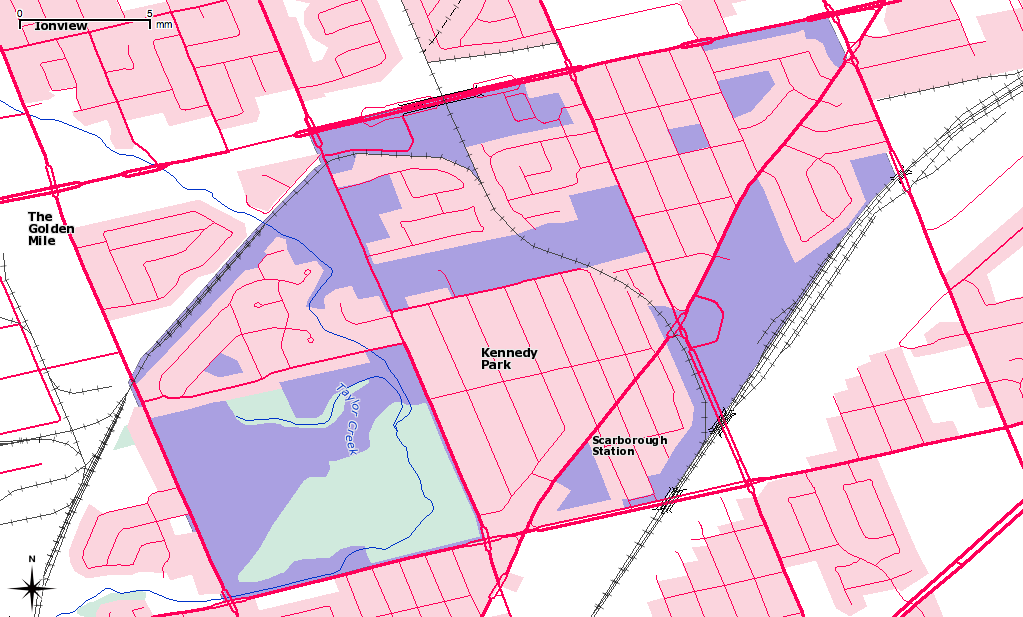
My neighbourhood, Kennedy Park, is pretty much defined by the CNR tracks at the southeast and northwest corners. This is Toporama Web Map Service data overlaid on the toronto.ca | Open neighbourhood polygon:
It’s all lit up! These are the houses in my streets, each one highlighted in QGIS:

More GIS nerdry at Numpty’s Progress.
Every thousandth track from my library:
| Track | Title | Artist | Album |
|---|---|---|---|
| 1000 | How the West Was Won and Where It Got Us | R.E.M. | New Adventures in Hi-Fi |
| 2000 | Lesson 8 / Ex 3 | David Hamburger | The Acoustic Guitar Method, Book 2 |
| 3000 | Way of Woe | Peter Stampfel | The Jig Is Up |
| 4000 | Exercise: Changing Chords | Jack Hatfield | First Lessons Banjo |
| 5000 | The Edison Museum | They Might Be Giants | No! |
| 6000 | Got The Jake Leg Too | Ray Brothers | |
| 7000 | Light Is Returning | Rise Up Singing: The Teaching Disc O | |
| 8000 | Birmingham Sunday | Rise Up Singing: The Teaching Disc J | |
| 9000 | Bring Me A Leaf From The Sea | Carolina Tar Heels | Mountain Frolic (Rare Old Timey Classics 1924-37) – Disc D (1925-30) |
| 10000 | Window to Mars | Elf Power | In a Cave |
| 11000 | The Book Of Doves | Alasdair Roberts | Spoils |
| 12000 | Grounded | Pavement | Wowee Zowee |
| 13000 | O Holy Night | Classic Carols | Classic Carols (Piano-Vocal Harmonies) |
| 14000 | Track 23 | Peter Gelling | Teach Yourself Harmonica |
| 15000 | Priscilla | The Soft Machine | The Soft Machine |
| 16000 | Colours | Gorp | Shapes And Colours Game |
| 17000 | The Mayor Of Simpleton | XTC | Upsy Daisy Assortment |
| 18000 | Jóga | Björk | Homogenic |
| 19000 | Everything Merges With the Night | Brian Eno | Another Green World |
| 20000 | Great Races – The Marathon | Ivor Cutler, et al | King Cutler, Part 6 |
| 21000 | Coal Creek March | Dock Boggs | His Folkways Years (1963-1968) Disc 1 |
| 22000 | The Ghost You Draw On My Back | Múm | Summer Make Good |
| 23000 | Tidy (Previously Unreleased Demo) | Dressy Bessy | Little Music: Singles 1997-2002 |
| 24000 | Careless Soul | Daniel Johnston | 1990 |
| 25000 | Introduction | Joyce Ochs | First Lessons: Dulcimer |
| 26000 | On A Monday Morning | Rachel Unthank and the Winterset | Cruel Sister |
I’ve started another blog: Numpty’s Progress. It’s more directed to what I want to do with GIS for now.
but it’s really a GIS layer with an exclusion buffer.


It was a cheesy time, the early 80s, but I’m stuck with it as my youth. Home computers were probably the largest part of my life for rather longer than I should admit.
My brother recommended Micro Men, a BBC 4 (what? they have more than two?) comedy drama about the fight between Acorn and Sinclair for the BBC educational contract. I went to my usual source for quality television, and it was on my computer an hour after hearing about it.
With a mix of vintage film and recreations, it caught the ’78-85 vibe perfectly. Whether all the anecdotes are historically correct, it doesn’t matter – the feeling of the frantic dash to develop new machines in ridiculously short times and then advertise them months before they were ready was there.
There were a bunch of good cameos, too. Nice to see Sophie Wilson (known to me as the author of Acorn’s BBC Basic, known to you as the designer of the ARM processor almost certainly used in your mobile phone) making an appearance.
So, though I was never a BBC B or ZX Spectrum owner, a fun programme, and one you might like.
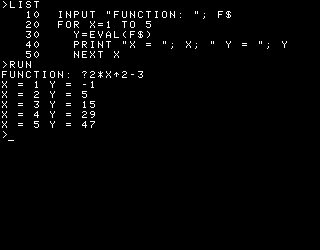
I came late to the BBC Basic game, but used it on my Z88 to ace an Introduction to Numerical Methods course (yay EVAL!).
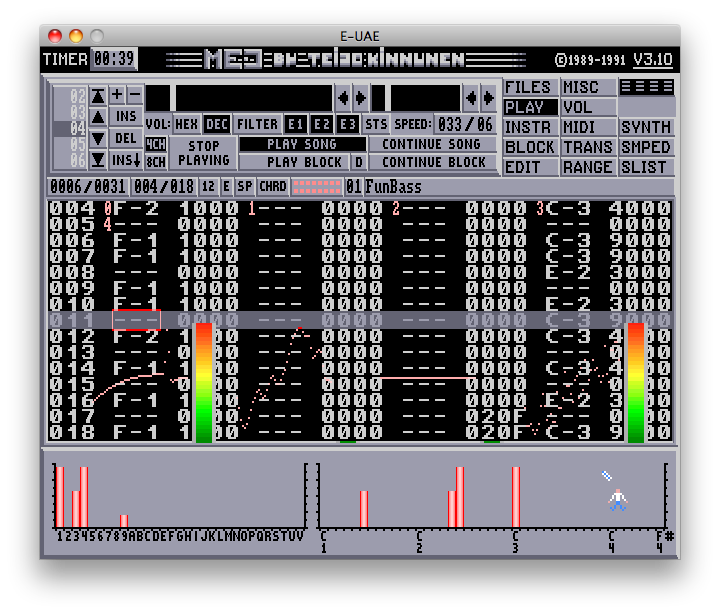 Multi-resolution screen? Check. Sprite-based VU bars? Check. Oscilloscope channel overlays? Check. Mouse pointer as a little dude who jumps up and down in time to the music? Check.
Only on Amiga …
 Truetype: