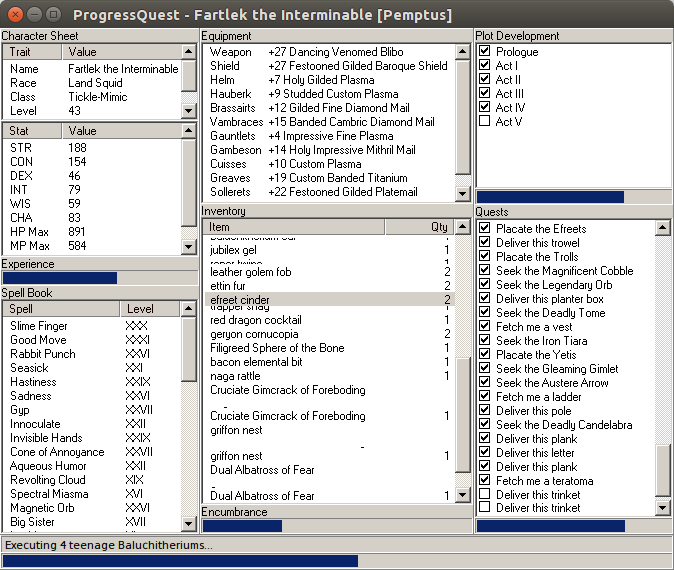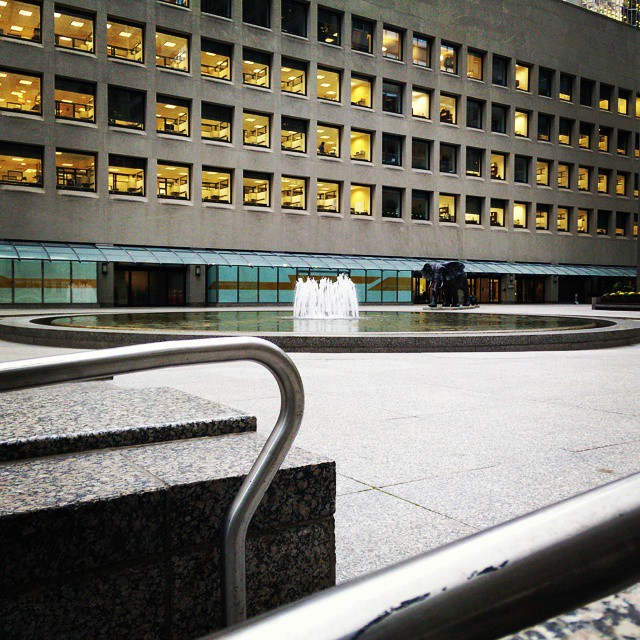

If I wished to get a tattoo (which I don’t), I think it would have to be this:
Blog
-
Everybody needs a Level 43 Tickle-Mimic
The display gets a bit mixed up under Linux, but Progress Quest is still delightful.It also has some of the best Release Notes ever:
 Changes for version 6.1:     * I really just don't remember.     * I also don't see how it could matter much.
Fetch me a teratoma!
-
Power, at what price?
It’s the Canadian Electricity Association’s Electricity in Ontario week. Can’t you feel it in the air? A brochure, snappily titled “ELECTRICITY ARE WE GETTING VALUE FOR THE MONEY WE PAY?†[pdf] was in my dead tree media stack this morning. I think it’s trying to say our power is too cheap, as in this graph yoinked from the text:
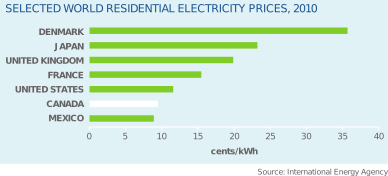
But as ever, hand-picked statistics only tell half the story. Digging into the IEA Key World Energy Statistics handbooks for 2011 and 2012, the data look something more like this:
Country
2010 Domestic Electricity Price / USD/kWh
2010 Annual Electricity Consumption per capita / kWh
Annual Cost per capita
Denmark
$0.356
6,329
$2,255
Japan
$0.232
8,399
$1,950
United Kingdom
$0.199
5,741
$1,142
France
$0.157
7,756
$1,216
United States
$0.116
13,361
$1,547
Canada
$0.095
15,145
$1,431
Mexico
$0.089
2,085
$185
So really, because Canadians use such an obscene amount of energy per capita (srsly; we should be ashamed of ourselves), the graph should look more like this:
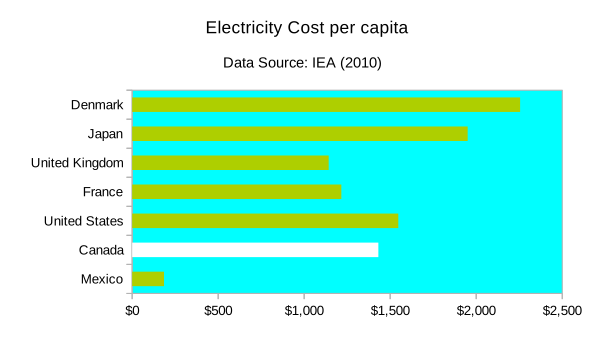
So we’re not actually that inexpensive; solidly mid-range. Since our electricity price per kWh is so low, if we spent a little money on energy conservation, we could have really cheap power for everyone.
-
The Yonge & St Clair Autoharp Guy
This guy sets up on the SE corner of Yonge & St Clair most afternoons, and plays endless variations on the above recording. He’s playing an autoharp with the chord bars removed, and run through a homebrew battery-powered amplifier with much reverb and distortion. A bunch of the burbly noises are 8kbit/s voice recorder artifacts from my phone.
Although the themes seem repetitive, I don’t think they repeat exactly every time. He seems to be in a happy place playing them.

-

Site of some epic head-crushings
-
Log your electricity consumption with Powermon433
NB: this is in the early stages of development, but does work. It’s by no means a plug-and-play solution. You’re going to have to do some coding, and perhaps some soldering. Undaunted? Read on …
I really like the Blue Line Innovations PowerCost Monitorâ„¢ (aka the Black & Decker Power Monitor EM100B). I bought one long before the OPA started to give them away free to Ontario households as part of their peaksaver PLUS program. It’s a little device that clamps to your hydro meter and sends instantaneous power readings to a display.

Power Monitor displays — Black & Decker on the left, Blueline on the right Wouldn’t it be so much better if you could log and analyze these data? So a day’s power consumption might graph to something like this:
Yup, this is my real electricity consumption, as logged from the PowerCost Monitor. You can see the fridge cycling on and off, and I think the big mid-day spike was either the AC or the dryer; someone was home on that Monday. The rather blocky green line is Toronto Hydro’s hourly smart meter data. It really hasn’t got the resolution to show really detailed power use.That spike at 06:30; what’s that? Let’s take a look:
That’s me boiling the kettle. You can see that the time resolution is better than a minute, and the power is to the watt. Mmm, coffee …All of this is recorded using a simple Arduino-based solution, originally cooked up by Bryan Mayland. I’ve forked his code and added some instructions: scruss/Powermon433. Here’s the rig I’ve been using to log data over a USB serial link:

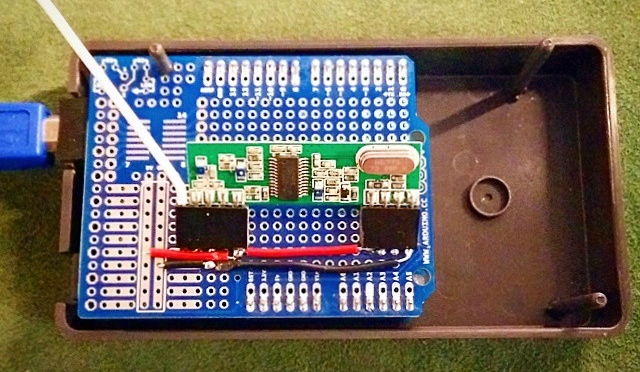
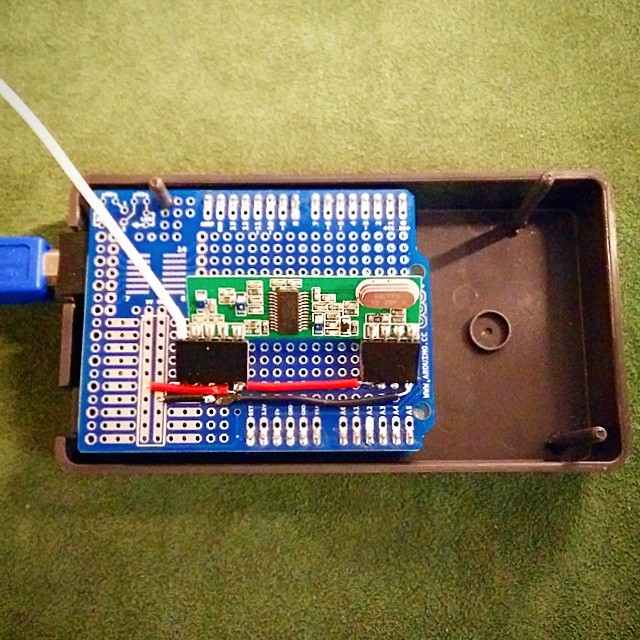
Arduino FIO compatible + RFM69W board + FTDI serial That’s a particularly ugly rig, due to the limitations of the 3.3 V receiver board I was using. There are other options that work with more normal Arduino boards up on github.
Here’s a sample of the data I’m logging, including the kettle incident:
Datetime Elapsed_s Energy_Wh Power_W Temp_C 2014-09-29T06:27:44 23241.7 25876 289 15 2014-09-29T06:28:16 23273.6 25876 290 15 2014-09-29T06:28:48 23305.5 25876 291 15 2014-09-29T06:29:20 23337.4 25892 294 15 2014-09-29T06:29:52 23369.2 25892 286 15 2014-09-29T06:30:24 23401.1 25892 277 15 2014-09-29T06:30:56 23433.0 25892 357 15 2014-09-29T06:31:28 23464.9 25892 1844 15 2014-09-29T06:32:00 23496.8 25892 1836 15 2014-09-29T06:32:31 23528.5 25952 1829 15 2014-09-29T06:33:03 23560.2 25952 1818 15 2014-09-29T06:33:35 23592.1 25952 1836 15 2014-09-29T06:34:07 23624.0 25952 1836 15 2014-09-29T06:34:39 23655.8 25952 1836 15 2014-09-29T06:35:11 23687.7 25952 1848 15 2014-09-29T06:35:43 23719.6 26048 1832 15 2014-09-29T06:36:15 23751.5 26048 2000 15 2014-09-29T06:36:46 23783.4 26048 2000 15 2014-09-29T06:37:18 23815.2 26048 2000 15 2014-09-29T06:37:50 23846.9 26048 368 15 You’ll see that I’m recording:
- a system timestamp
- the elapsed logging time, from the Arduino’s clock
- instantaneous meter readings in watt-hours. Note that not every row has an update
- the average power since the last record. The product of this and the time between records adds up to the energy consumption
- the outside temperature in °C. This is not very accurate (in full sun it over-reads vastly) but better than nothing.
Compare that to the smart meter data:
DateTime Hour KwhUsage Cost Rate 2014-09-29 05:00:00 5 0.29 $0.02 $0.075 2014-09-29 06:00:00 6 0.31 $0.02 $0.075 2014-09-29 07:00:00 7 0.59 $0.04 $0.075 Not much data there, is there? Certainly not enough resolution to tell if a kettle has been running.
Even though this interface is homebrew and cheap, it is accurate. Here’s how four days of continuous readings stack up against Toronto Hydro’s meter:
 Power Monitor ndToronto Hydro Smart Meter Day First Reading / Wh Last Reading / Wh Total Consumption / kWh No of readings Daily Total / kWh No of readings 2014-09-29 23896 43668 19.772 2711 19.77 24 2014-09-30 43668 52500 8.832 2710 8.82 24 2014-10-01 52500 68004 15.504 2711 15.51 24 2014-10-02 68004 81996 13.992 2712 13.99 24 The difference looks to me like aliasing; THES’s reporting is much more granular.
I’m going to develop this further to turn it into an easy (or at least, easier) to use logging platform. It’s taken us a few years to get here, but there’s nothing quite like a project finally working!