Category: goatee-stroking musing, or something
-
just hope I didn’t get a wee girl’s christmas present by mistake
This arrived today:
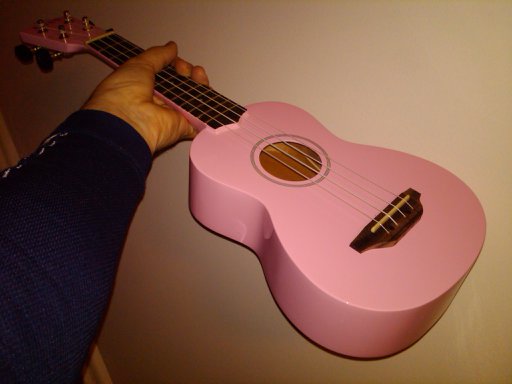 A bright pink EMUS soprano ukulele from Empire Music. I’m confused — not merely because I’ve never known Canada Post to deliver on a Sunday, but:
- I haven’t ordered from Empire since 2007
- I have a ukulele already
- I’m relatively unlikely to have ordered a pink one.
It actually plays quite well — but where did it come from?
-
aah! my eyes!
Seems that Shangri-La Toronto wants to surround their building with a bright magenta billboard. This is the view from my office:
 It’s so bright everything vaguely reflective on my desk appears to be pink. I’ve made a couple of calls to the City of Toronto – Sign By-law Unit and Toronto 311 and await developments.
 -
ecofont: somebody drilled out a font
Ecofont claims to help you save ink (and not mass, like drilled out bike bits). The approach is the same:
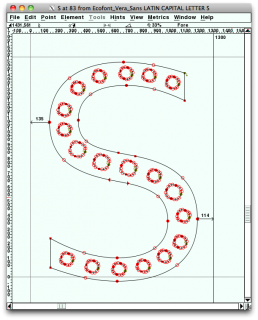 Both of my printers have ink-saving settings that avoid this horror. Plus, y’know, with print to PDF, who wants paper?
 -
for perfect hotel sleeping …
- ensure that the ventilation system sounds like an idling Morris Minor
- insist that the alarm clock has a brightly-backlit display that won’t turn off, and is curved, so light will leak out no matter what you block it with
- smoke alarms must have a flashing LED bright enough to cause retinal POV trails.
Yes, Downers Grove Doubletree Guest Suites, I’m talking about you.
-
now that’s a loaf
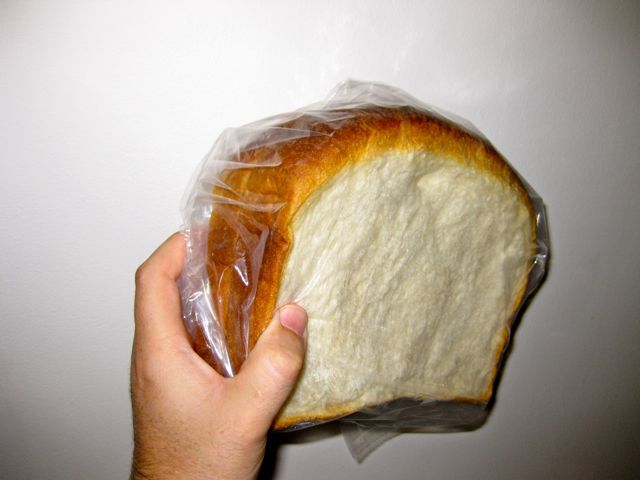 Been discovering the joys of Poondy Bread, the nearby Sri Lankan bakery. Their bread is awesome, with a great egg crust and a challah-like sweetness.
But this loaf takes the cake. Two colossal slices. As big as your head.
-
… that our fries were still there
Following on from this, here’s another anthem performed by the Five Guys and the Arduino Micro Cup Orchestra:
Converted from a midi file found at American and Patriotic Midi Music (unsurprising caution: autoplay midi music therein) to RTTL using MIDI to RTTL.
If you just want the source, here it is:
star-spang:d=4,o=5,b=80:2p,8f.,16d,a#4,d,f,2a#,8d.6,16c6,a#,d,e,2f,8f,8f,d.6,8c6,a#,2a,8g,8a,a#,a#,f,d,a#4,8f.,16d,a#4,d,f,2a#,8d.6,16c6,a#,d,e,2f,8f,8f,d.6,8c6,a#,2a,8g,8a,a#,a#,f,d,a#4,8d6,8d6,d6,d#6,f6,2f6,8d#6,8d6,c6,d6,d#6,2d#6,d#6,d.6,8c6,a#,2a,8g,8a,a#,d,e,2f,f,a#,a#,8a#,8a,g,g,g,c6,8d#6,8d6,8c6,8a#,a#,a,8f,8f,a#.,8c6,8d6,8d#6,2f6,8a#,8c6,d.6,8d#6,c6,1a#
-
Hester the Moonlight Deer
Catherine and I made a shadowbox using my Springfield deer photo: Hester the Moonlight Deer.
-
if you can measure it …
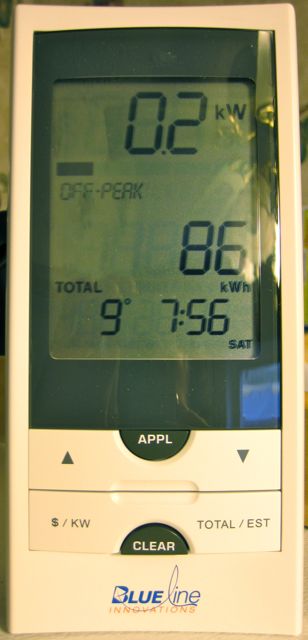
I’ve had the PowerCost Monitorâ„¢ up and running for over a week now. It was pretty easy to fit. The fiddliest bit was working out and entering the time-of-use rates – which I’ll have to change again in November.
Over the last six days that I’ve been logging it, it exactly matches our meter. That’s one of the reasons I bought it; I didn’t want to be fiddling with CT clamps which introduce their own inaccuracies. Now for the small matter of decoding its transmissions …
-
Actually, I don’t think that the Notional Past was being ironic
 It’s hard to call anything “breakaway” when the combined current ages of the proponents would put them born in the same week as Lord Rayleigh. The major schism would be over who had the more outlandish hat: radar station vs lampshade.
 -
The Sharpie Liquid Pencil – massive letdown
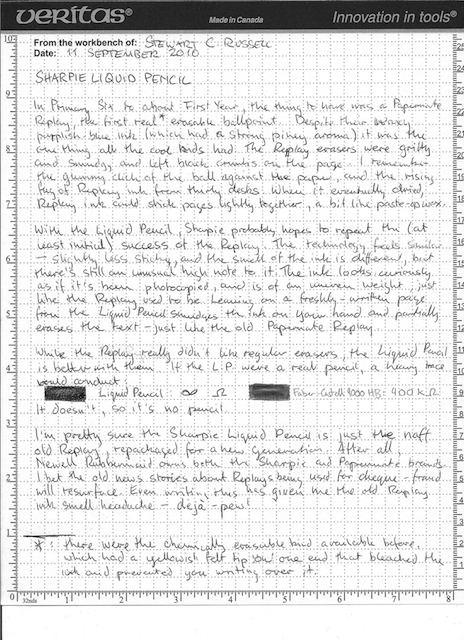
In Primary Six to about First Year [so about 1979 to 1981], the thing to have was a Papermate Replay, the first real* erasable ballpoint. Despite their waxy purplish-blue ink (which had a strong piney aroma) it was the one thing all the cool kids had. The Replay erasers were gritty and smudgy, and left black crumbs on the page. I remember the gummy click of the ball on the paper, and the rising fug of Replay ink from thirty desks. When it eventually dried, Replay ink could stick pages lightly together, a bit like paste-up wax.
With the Liquid Pencil, Sharpie probably hopes to repeat the (at least initial) success of the Replay. The technology feels similar — slightly less sticky, and the smell of the ink is different, but there’s still an unusual high note to it. The ink looks curiously as if it’s been photocopied and is of an uneven weight, just like the Replay used to be. Leaning on a freshly-written page from the Liquid Pencil smudges the ink on your hand and partially erases the text — just like the old Papermate Replay.
While the Replay really didn’t like regular erasers, the Liquid Pencil is better with them. If the LP were a real pencil, a heavy trace would conduct:
███ Liquid Pencil: ∞Ω ███ Faber-Castell 9000 HB: 400kΩ
It doesn’t, so it’s no pencil.
I’m pretty sure the Sharpie Liquid Pencil is just the naff old Replay, repackaged for a new generation. After all, Newell Rubbermaid owns both the Sharpie and Papermate brands. I bet the old news stories about Replays being used for cheque-fraud will resurface. Even writing this has given me the old Replay ink smell headache — déjà pew!
———
* there were the chemically erasable kind available before, which had a yellowish felt tip on one end that bleached the ink and prevented you writing over it.Unscrewing the barrel revealed the familiar old Papermate Replay refill. I think we’ve been had.
Update: a bunch of reviews. The ones that actually tried it came to pretty much the same conclusion:
- Sharpie Liquid Pencil Review :: OfficeSupplyGeek
- Sharpie Liquid Pencil writes and erases like a pencil, dries like a Sharpie (video hands-on!) — Engadget
- Review: Sharpie Liquid Pencil
- Sharpie Reinvents Pen with Liquid Pencil | Gadget Lab | Wired.com
- Hands-on with Sharpie’s Liquid Pencil | Beyond Binary – CNET News
- Sharpie liquid pencil – Boing Boing
- Sharpie creates Liquid Pencil that becomes permanent after 3 days – New Tech Gadgets & Electronic Devices | Geek.com
-
OooOooh!
Toronto Hydro’s PowerLens for BlackBerry is quite neat:
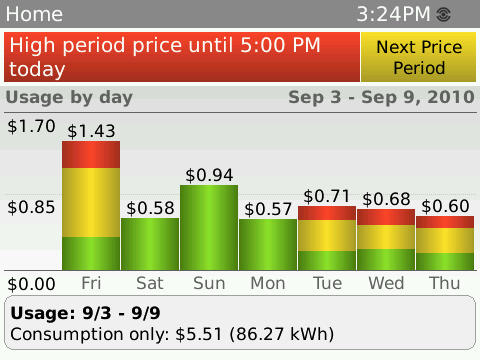 That’s real data from my home meter, folks.
 -
Thumbs up for Offshore Wind!
If you want to work out how tall a wind turbine is at a distance, you can use simple proportion:
If I hold my thumb at arm’s length, it’s about a metre from my eye. The tallest a turbine would appear from shore would be equivalent to the height of the top joint of my thumb. That’s pretty small. -
My comments on the “Renewable Energy Approval Requirements for Off-shore Wind Facilities”
Dear Mr Duffey
EBR Registry Number: 011-0089
Renewable Energy Approval Requirements for Off-shore Wind Facilities – An Overview of the Proposed ApproachI would like to propose that the mandatory 5km shoreline exclusion be removed entirely, for the following reasons:
1 Drinking Water Source Setbacks
While the “Technical Rules: Assessment Reportâ€1 of the Clean Water Act 2006 is cited as a major reason for the 5km shoreline setback, the assessment report itself provides for no greater setback than 1000m from a water intake in a Great Lake. It is suggested that this one kilometre setback be maintained for existing and planned intakes, but should not be applied as a blanket distance for all development. To force a larger setback than the Act allows is to discriminate against wind energy and the industry.2 Lake Bathymetry
Taking the particular case of Lake Ontario near Toronto, the water depth at 5km from shore is typically2 40-70m. This is far greater than is practical, and would require massive and costly foundations.
3 Noise
The proposed shoreline exclusion unscientifically precludes any project coming closer to shore. As your document states that noise guidelines for offshore projects are in development, setbacks derived from these guidelines should be allowed. The document should also clarify that the 5km shoreline exclusion is typically larger than the setback required by the Noise Guidelines for Wind Farms3, as at a recent MOE session on Low Frequency Noise Measurement4, representatives of “The Society for Wind Vigilance†stated that 5km was now the setback recommended by the MOE for all wind projects.4 Positive Visual Enhancement
Wind energy is the most visual form of electrical generation, and it is a subjective matter as to whether the turbines are ugly or beautiful. The major shoreline constraint cited by the Ohio Department of Natural Resources is due to “aesthetic hindranceâ€5, yet the Great Lakes Wind Energy Center’s Final Feasibility Report6 wishes to site their pilot turbine as close to shore for “the highest iconic valueâ€. Copenhagen, the capital city of Denmark, has an arc of wind turbines in the bay approximately 3km from the shore, and less than 5km from the Amalienborg Palace. By placing these turbines close to the city, they have made a statement of their commitment to sustainability, and avoided rows of pylons, which few (if any) could call anything but ugly.I would hope that you would take my comments into account.
Yours sincerely,
Stewart C. Russell, P.Eng.
References:
4 12th August – 2300 Yonge St – 9:30-11:30am.


 Well, I liked it …