There's an xscreensaver module called Julia that displays
this rather more prettily. But hey, do they supply the source in
Fortran-77? Sorry about using GIFs too; I know they're a
dreadful format, but they work here.
Julia Set Animation
What it is
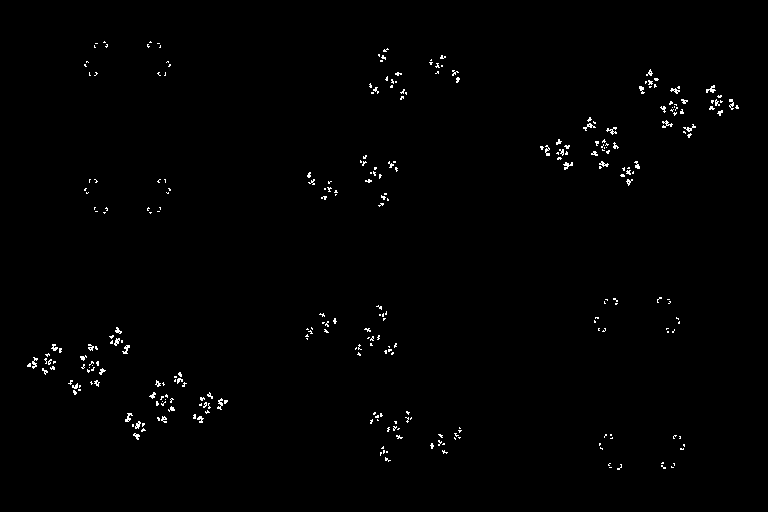 It's a sequence of Julia sets for the points at 5° intervals
around the unit circle. It's something I wrote up in an edition
of Fractal Report in the early 1990s. I animated it then
in BASIC on an Amiga 500. Now, it's more accessible as a GIF
animation, and the code (in an eclectic mix of Fortran77 and
Perl) is presented for your "enjoyment".
It's a sequence of Julia sets for the points at 5° intervals
around the unit circle. It's something I wrote up in an edition
of Fractal Report in the early 1990s. I animated it then
in BASIC on an Amiga 500. Now, it's more accessible as a GIF
animation, and the code (in an eclectic mix of Fortran77 and
Perl) is presented for your "enjoyment".
Explanations of the mathematics are in Peitgen &
Saupe's book The Science of Fractal Images,
Springer-Verlag. They do it better than I ever could.
How to do it
You'll need a system with Fortran, Perl, NetPBM and some kind of
GIF animator. These days, cheapo PCs have quite incredible maths
facilities, so you can do in a few minutes what took my old
Amiga 500 all night.
First, cut out and compile the following Fortran. It really helps
if you call the executable jliim3, otherwise, you'll
have to redo the Perl driver.
      program jliim3
c julia iim from "the science of fractal images"
c computes Julia sets by inverse iteration
      integer width, height, maxit
      parameter(width=256, height=256, maxit=100000)
      integer m(width,height)

      pi = 4.0 * ATAN(1.0)
      hpi = pi / 2.0
      READ(UNIT=*, FMT=*) cx, cy
      x = cx
      y = cy

c make array white-on-black
      DO j=1,height
         DO i=1,width
            m(i,j)=1
         END DO
      END DO

      DO i = 1, maxit
        wx = x - cx
        wy = y - cy

        IF (wx.gt. 0.0) THEN
                theta = ATAN(wy / wx)
        ELSE
                IF (wx .lt. 0) THEN
                        theta = pi + ATAN(wy / wx)
                ELSE
                        theta = hpi
                END IF
        END IF
        theta = theta / 2.0
        r = SQRT(wx**2 + wy**2)
        IF (rand(0.0) .lt. 0.5) THEN
                r = SQRT(r)
        ELSE
                r = -SQRT(r)
        END IF
        x = r * COS(theta)
        y = r * SIN(theta)
c        write(unit=*,fmt='(2f7.4)')x,y
        if (i .gt. 10) then
           m((width/2)+int(x*real(width/4)),
     $          (height/2)+int(y*real(height/4)))=0
c J-sets are symmetrical through the origin
           m((width/2)-int(x*real(width/4)),
     $          (height/2)-int(y*real(height/4)))=0
        end if
      END DO

c Now write PBM file
      write(unit=*,fmt='(A)')'P1'
      write(unit=*,fmt=*)width,height
      do j=1,height
         do i=0,(width/64)-1
            write(unit=*,fmt='(64I1)')(m(l,j),l=1+64*i,(64*i)+64)
         end do
      end do

      END

c this is a free random number routine I found somewhere
      function rand (r)
c r      if r=0., the next random number of the sequence is generated.
c        if r.lt.0., the last generated number will be returned for
c          possible use in a restart procedure.
c        if r.gt.0., the sequence of random numbers will start with the
c          seed r mod 1.  this seed is also returned as the value of
c          rand provided the arithmetic is done exactly.

c             output value --
c rand   a pseudo-random number between 0. and 1.

c ia1 and ia0 are the hi and lo parts of a.  ia1ma0 = ia1 - ia0.
      data ia1, ia0, ia1ma0 /1536, 1029, 507/
      data ic /1731/
      data ix1, ix0 /0, 0/

      if (r.lt.0.) go to 10
      if (r.gt.0.) go to 20

c           a*x = 2**22*ia1*ix1 + 2**11*(ia1*ix1 + (ia1-ia0)*(ix0-ix1)
c                   + ia0*ix0) + ia0*ix0

      iy0 = ia0*ix0
      iy1 = ia1*ix1 + ia1ma0*(ix0-ix1) + iy0
      iy0 = iy0 + ic
      ix0 = mod (iy0, 2048)
      iy1 = iy1 + (iy0-ix0)/2048
      ix1 = mod (iy1, 2048)

 10   rand = ix1*2048 + ix0
      rand = rand / 4194304.
      return

 20   ix1 = amod(r,1.)*4194304. + 0.5
      ix0 = mod (ix1, 2048)
      ix1 = (ix1-ix0)/2048
      go to 10

      end
The above program just takes a coordinate pair on standard
input, and writes a 256x256 pixel PBM file to standard
output. The Perl driver (below) just calls the program many
times, feeding it different coordinates, and converting the
output to GIF files called j000.gif to j355.gif.
#!/usr/bin/perl -w
# animjulia - created by scruss on Sat Jun 6 17:39:45 BST 1998

use strict;
my $pi = 4 * atan2(1,1); # const
my $a=0;

while ($a < 360) {
    my $theta = $a * $pi / 180;
    my $x = cos($theta);
    my $y = sin($theta);
    my $f = sprintf("j%03d.gif",$a);
    system "echo $x,$y | jliim3 | ppmtogif -sort > $f\n";
    print STDERR $a, "\n";
    $a += 5;
}
exit;
You've now got a directory-full of GIF files. Stick 'em together
with your favourite animator (I used whirlgif), and groove.
You can try using coloured fractal images, but in my experience
they don't look so good. They look far too determinedly trippy;
that's why I use them for a video for that quality Glasgow
venue, Shag (Wonder what ever happened to them?).

Stewart C. Russell,
Kirkintilloch, Scotland