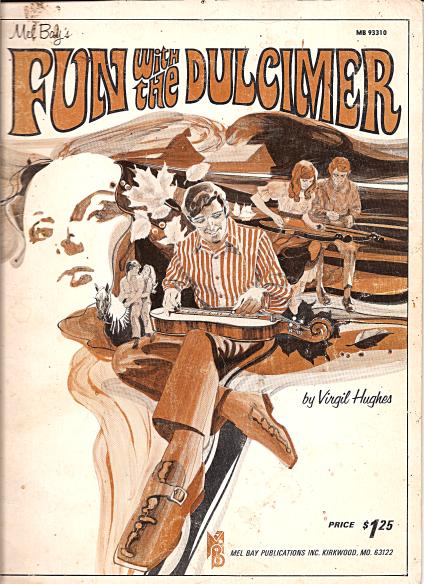
Floaty-haired woman motif? Check
Happy couple riding a horse? Check
Elaborate, possibly ill-advised, used of perspective? Check
Fashions suggesting high polyester content? Check
Friends, I give you Mel Bay‘s Fun With The Dulcimer:
work as if you live in the early days of a better nation
recent dead-tree assimilations
Floaty-haired woman motif? Check
Happy couple riding a horse? Check
Elaborate, possibly ill-advised, used of perspective? Check
Fashions suggesting high polyester content? Check
Friends, I give you Mel Bay‘s Fun With The Dulcimer:

In case anyone wants them, the 600 dpi page images of What a Life! are stored in this PDF: what_a_life.pdf (16MB). If you merely wish to browse, all the images from the book are here.
I got a bit carried away with doing this. Instead of just smacking together all the 360 dpi TIFFs I scanned seven years ago, I had to scan a new set at a higher resolution, then crop them, then fix the page numbers, add chapter marks, and make the table of contents a set of live links.
I’ve got out of the way of thinking in PostScript, so I spent some time looking for tools that would do things graphically. Bah! These things’d cost a fortune, so armed only with netpbm, libtiff, ghostscript, the pdfmark reference, Aquamacs, awk to add content based on the DSC, and gimp to work out the link zones on the contents page, I made it all go. Even I’m impressed.
One thing that didn’t impress me, though:

I used to edit multi-gigabyte files with emacs on Suns. They never used to complain like this. They just loaded (admittedly fairly slowly) and let me do my thing. Real emacs don’t give warning messages.
Lots of people are drooling over the book Rule the Web. I’m not, particularly. It’s good in parts, but reminds me so much of those mid-late 1990s “Best Web Directory Ever” tomes that are currently propping up shelves in bargain bookstore, and propping up houses built on landfills in Arizona.
My biggest complaint is its US-centric approach. Pretty much everything related to buying, selling or finding people or things mentioned in the book only applies to the USA.
As is the way when web meets paper, some things are out of date already. It happens, but it’s a shame when the book’s pretty new in the shops.
I did find a couple of things I genuinely didn’t know about, but might find useful:
It also gave links to OnyX and HandBrake, both of which I already use. But that’s about it. I’d have been peeved if I bought the book (yay, Toronto Public Library!), as this is more of a basic manual than a compendium of coolness.
Project Gutenberg Canada / Projet Gutenberg Canada opened its doors a couple of days ago. It’s gone through several organisers since I first heard of its imminent launch in 2002, but I’m glad it got going.
Craig Ferguson’s Between the Bridge & the River is better than I expected. It’s a long way from live at the Tron, eh?
When tiger-men sat their mercurial coursers,
Hauled into shuddering arches the proud fibre
Of head and throat, sank spurs, and trod on air—
I was not there. …
When clamorous centaurs thundered to the rain-pools,
Shattered with their fierce hooves the silent mirrors,
When glittering drops clung to their beards and hair—
I was not there. …
When through a blood-dark dawn a man with antlers
Cried, and throughout the day the echoes suffered
His agony and died in evening air—
I was not there. …
— Mervyn Peake
Toronto Public Library Finder; nice, but I was so on that game months before …
One of the baddies in Upton Sinclair’s The Jungle is a political henchman called Bush Harper. No further comment is required.
Philip Gosse’s The Pirates’ Who’s Who, from Project Gutenberg.
Christmas came early. With money from Carlyle, I bought a reproduction of Knight’s American Mechanical Dictionary, a three-tome work from the 1870s which catalogued mechanisms, devices and machinery known at the time. It’s the ultimate nerd read.
You can browse two electronic versions online:
I have to say, though, that the dead tree version is a splendid read.
I was supposed to have a book on the Golden Ratio waiting for me, but instead they had the Bernardin Complete Book of Home Preserving.
Catherine has a project involving Toronto’s libraries, and so I, for no particularly good reason, compiled a geocoded list of the Toronto Public Library system: libraries.gpx
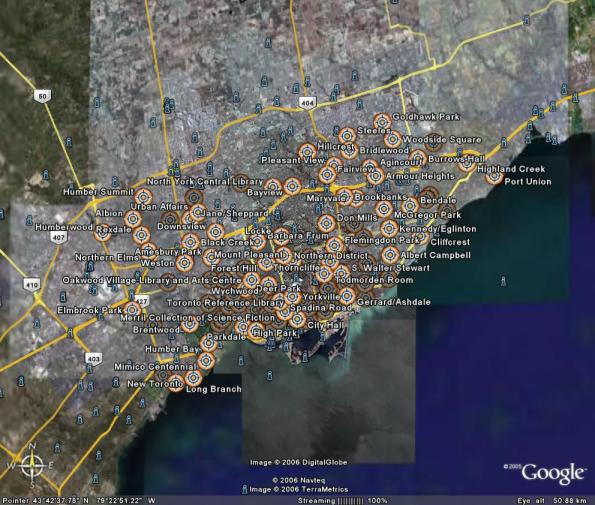
You can thank MapSource for the bloated GPX file. It quadrupled in size when I changed the symbols to look like buildings.
Just finished Timothy; or, Notes of an Abject Reptile, the fictional thoughts of Gilbert White‘s pet tortoise. Verlyn Klinkenborg has really captured the pace of the tortoise’s life.
The tortoise/taught us rhyme doesn’t work if you’re Scottish; we pronounce it tor-toys, not taw-TUSS. Lewis Carroll didn’t think beyond the RP.
In memory of Timothy, I’ve geotagged this post with the location of a bridge in a nearby ravine, near which a little turtle used to snooze in the sun.
There was one thing I hated about Rumo, and that was finishing it. Walter Moers creates such a complex — yet never serious — fantasy world that leaving it is always hard.
I like the way he’s not afraid to revisit characters from The 13½ Lives of Captain Bluebear. Most fantasy authors are slavish in keeping their characters’ lives consistent across the volumes. Since Bluebear was the most celebrated liar in Atlantis, what do you expect?
Aargh, I hate finishing an Eric Garcia Rex book. I don’t get lost in too many books, but Eric’s ones do that for me. I’d finished Hot & Sweaty Rex, then re-read Anonymous Rex ‘cos I couldn’t get enough of that dino-noir (dinoir?)
Garcia’s books are clearly works of fiction. I mean, to say that 5% of the population are dinosaurs in heavy disguise — the real number’s much higher …
I found a copy of Linda McQuaig’s It’s the Crude, Dude on the GO train last night. I’ve been meaning to read it for a while. I don’t know what I’ll do with it when I’ve read it — Bookcrossing?
I’ve just been listening to BBC Radio 4‘s dramatisation of Edmund Gosse’s Father and Son. It’s rather good.
I think I can safely say that this household knows more about Edmund Gosse than any other in Scarborough. Catherine‘s PhD was based on on the Gosse family, and I’ve read the book and proof-read the thesis. I suspect we’re also the only household in Scarborough that relates episodes from the young life of Edmund Gosse as if they were family anecdotes.
I know, we must get a life …
Just finished Laura Penny‘s snarky, angry, funny, clever Your Call Is Important To Us, on the pervasiveness of bullshit. This is basically a book that Bill Hicks never got to write. It’s delightful.
(the subject’s a line from the ever-hilarious Fertnel Snak Food Corporation, btw).
The TTC was full of adults reading the new Harry Potter. I guess it’s true what they say about the decline in reading age.
Wendy sent me Iain Banks’s Raw Spirit for my birthday, and I’ve just finished it. I very much enjoyed it; it’s more of an autobiography by way of some whisky distilleries. We have favourite drams in common — Laphroaig and Balvenie being a couple — and we both have a failing for Mull Cheddar, the potency of which can only be described as sinus-clearing. It’s an amusing read, and you don’t have to be a whisky nerd or Banks geek to enjoy it.
I applaud Iain Banks’s stand on the Iraq war, but I do wonder if he’s thought very hard about the the cause of the war. Banks witters on (sorry, but he does so, incessantly) about being a “petrolhead”, and describes his cars in intricate detail: LandRover TD5, BMW M5, Porsche 964 Carrera 4, Porsche 911, Jaguar MkII 3.8l. None of these have sane fuel economy, and fewer of these on the road might’ve meant we wouldn’t have needed to get palsy with the odious Hussein, then need to oust him later. Maybe the fumes — whisky, weed or petrol — went to Banksie’s head.